
A hundred-year stagnation? For who?
By Alberto Forchielli via Caixin | The prospects for growth in the West may be dim, but that doesn’t mean Asia’s developing countries must settle for privation.

By Alberto Forchielli via Caixin | The prospects for growth in the West may be dim, but that doesn’t mean Asia’s developing countries must settle for privation.

MADRID | The Corner | The ruble plummeted on Monday, suffering its worst daily fall since Russia’s 1998 crisis, plunging more than 6% against the dollar before recovering to losses of around 4% Lowering oil prices are killing the currency, and yet Moscow does not intend to cut production in 2015, leaving output at the current 525-526 million metric tons. Russian analysts commenting for The Corner explained there is enough currency liquidity in the market to handle the shock. At least for now.

MADRID | By Sean Duffy | The OECD´s economic outlook showed that voices calling for action in Europe are growing louder. With the outcomes of austerity and budgetary consolidation continuing to drag down the economy, Catherine L Mann´s arrival as its chief economist represents a significant coup for advocates of the opposite recipe.
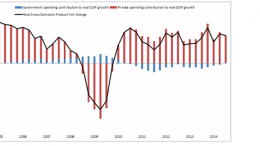
SAO PAULO | By Marcus Nunes via Historinhas | Why? According to the “accountants”: “It’s no secret that spending cuts (and tax hikes) have retarded America’s growth for the past four years. But data from the Bureau of Economic Analysis suggests that the era of austerity may finally have ended.” See the “flagship chart” above.

MADRID | By Luis Arroyo | Austerians are fighting back, but retreating. At least in what concerns the best Keynes, the financial Keynes, I guess. Three years ago the OECD was calling for a general rates hike. Now, under another leadership, the Paris-based institution is asking for fiscal and monetary stimulus, mostly in Europe.
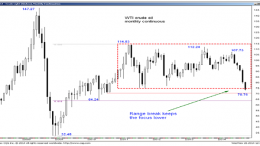
MADRID | The Corner | Oil prices continue to fall ahead of the much-awaited OPEC meeting today, which will start at 9:00GMT –a press conference will be held at 15:00GMT. Brent crude and WTI both fell to four-year lows on concerns that oil producers will not make the large supply cuts needed to contain the slide. Analysts at Barclays believe that with an absence of basing signals for WTI crude, the risk remains lower towards 70.76. Will the oil cartel react?

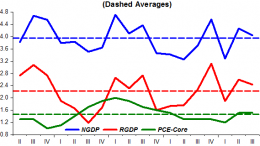
SAO PAULO | By Marcus Nunes via Historinhas | There´s absolutely nothing new on the economic front! So why there´s so much talk about “policy normalization” (i.e. increase in rates)?
Maury N. Harris, Drew T. Matus, et al. (UBS) | The National Retail Federation (NRF) has released its estimates for a 4.1% y/y rise in holiday sales—among the stronger growth forecasts in recent years. Although sales have fallen short of NRF expectations in each of the last two years, trends in income and confidence suggest better for this year. Falling energy prices also help.
By Jian Chang (Barclays) | The PBoC announced after the market close on Friday it was lowering the benchmark interest rates, effective 22 November 2014. The cut will be asymmetric, with the 1y lending rate down by 40bp to 5.6% and the 1y deposit rate down by 25bp to 2.75% (Figures 1 and 2). Meanwhile, the central bank further advanced its interest rate liberalization agenda. Banks can offer deposit rates at 20% above the benchmark rate, up from 10% currently (the upward flexibility was first introduced in June 2012, also along with a 25bp cut in the deposit rate). The bank also removed the benchmark guidance for the 5y savings rate.