
Gains in competitiveness to continue in Spanish economy
The Corner | April 2, 2015 | La Caixa Research | Competitiveness gains in the Spanish economy are set to persist as wage increases continue to lag behind other euro zone countries.

The Corner | April 2, 2015 | La Caixa Research | Competitiveness gains in the Spanish economy are set to persist as wage increases continue to lag behind other euro zone countries.

FRANKFURT | By Lidia Conde | Martin Gornig is deputy head of department of Firms and Markets at the prestigious German Institute for Economic Research (DIW) in Berlin. The Institute conducts a working group that advises the Minister of Economy Sigmar Gabriel with the idea of increasing investments in Germany. Gornig and his team released a report last summer on the possibility of stimulating growth in Europe without changing the Stability Pact. The proposal of DIW is to immediately mobilize the necessary investments “to boost growth in countries in crisis and avoid a new recession in the eurozone.” As France and Italy are demanding, the Institute bets on growth but warns that it should not be at the expense of a debt increase

LONDON | By The Corner | The Spanish Tax Agency published on Monday its monthly statistics on large enterprises. Experts at Barclays explain that among others, the May data show that wages dropped 0.3% y/y (sa and wda) for these firms. The average monthly wage increase in Jan-May period was -0.2% y/y, which coincides with the average monthly salary growth increase since the main 2012 labour market reform in Spain.
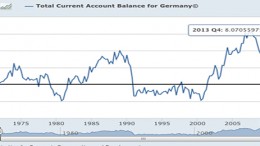
BERLIN | By Alberto Lozano | It’s not all about the deficit. If the eurozone wants to achieve the goal of sustainable growth, Germany also needs to shorten its chronic current account surplus, the world’s largest, which has led the country to accumulate capitals abroad amounting 100% of its GDP. Although this means dismissing one its economic miracle recipes -wage moderation-, Merkel will increase public workers’ salaries by 3% this year, +3X inflation.
MADRID | By Luis Arroyo | There was a deflation period in Europe at the peak of the crisis in 2008-2010. Demand policies all around the world erased it and prices increased to 3% annual rate. Then, the resulting austerity policies brought us back to deflation.
LONDON | Is there in these recent Brazil’s data a lesson for those in the Old Continent whose only talk is internal devaluation via salary cuts to regain competitiveness, while keeping the common currency too high for irrational fear of the inflation ghost? March brought a negative surprise with consumer credit non-performance rates in Brazil, which ticked up to 7.6% after having fallen to 7.4% in February. But that shouldn’t be…
By Luis Arroyo, in Madrid | I give you today a couple of graphics, which measure how the process of internal devaluation is going in that peripheral crown, Spain. First, the industry labour costs (wages, red line) and producer prices. Then, industrial production. Everything in annual variations. As readers can see, the boom years were not quite as buoyant in terms of industrial production. Meanwhile, wages were well above the prices, at 4%, trimming production margins. It is a reflection of the brick-and-morter boom, which revitalised wages and sturdy houses…