
Welcome to the New Normal in China
BEIJING | By Xiu Gao via Caixin | The annual Central Economic Work Conference report sketches a framework for looser monetary policies and adjustments to slower economic growth in China.


BEIJING | By Xiu Gao via Caixin | The annual Central Economic Work Conference report sketches a framework for looser monetary policies and adjustments to slower economic growth in China.

ZURICH | UBS analysts | Corporate bond markets in Europe have been quite resilient through these past few sessions in both IG and HY, offering relatively good outperformance. It would appear it is increasingly becoming a case of just buy it (corporate bonds), because that’s what’s best. Don’t worry, one will be looked after – the ‘structure’ after all is in place. There may be no growth, but you are promised low interest rates (zero at the front end), low funding yields (lowest ever, iBoxx corporate bond yields at 1.4%), a low default rate (less than 3%) and your money back at maturity.

MADRID | The Corner | Former member of the Executive Board of the European Central Bank (2004-2012) and BBVA’s José Manuel González Páramo believes the Frankfurt-based institution may currently have a “a sales problem.” “It operates in a different context from that of the US. Incidentally, the US was starting to realise what was going on in the markets by the end August 2007, when the ECB was already flooding the European market with liquidity. The ECB does not have the mandate of all Europeans to do everything Europe needs: providing liquidity, supervising the banks, acting instead of the Commission where the Commission does not act, acting instead of the Council or lecturing its members…,” he explained.
ZURICH | UBS analysts | In addition to setting out our thoughts by sub-sector (capex, mobile devices, semis), we outline themes and stock specific catalysts for 2015, including a review of potential M&A and possible hikes in cash returns. We also highlight each stock’s investment drivers (positive and negative) through 2015. In general we see another robust year for semi capex, softer telecom capex (but stable vendor revenue), ongoing strong growth in low end smart-phones, a medium-term inventory correction in analog semis (with solid underlying trends), and the continuing emergence of mobile payments.
MADRID | The Corner | Almost 8,000 companies were created in Spain in October, according to official figures, around 3% more y-o-y. The rate of businesses destruction went down by -12.2%, showing the economy’s slight improvement. However, unemployment still sits painfully at 23.7% and entrepreneurs still complain about red tape and other restrictions.
ZURICH | UBS analysts | We have painted a fairly sombre picture for emerging markets assets next year. Our base case is that EM debt will generate returns of 0-2%, while EM equities should yield 5-7% returns for USD based investors. The main thesis that underlies this view is that the growth alpha between EM and DM will fall further, with sluggishness in exports a critical concern.
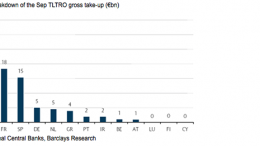
By Giuseppe Maraffino (Barclays) | On Thursday, December 11, the ECB will carry out its second TLTRO. The allotment results will be out at about 10:15 London time. The size of the new liquidity injected will be clear on the settlement of the operation, on Wednesday, 17 December, which is also the settlement day of next week’s MRO and of the weekly 3y LTRO repayment. However, the announcement on Friday, December 12, of next week’s 3y LTRO repayment will provide some insights on the new liquidity injected.
ZURICH | UBS analysts | We see 4 wins for Germany in a backdrop of falling oil prices
1) German equity market is not exposed to Oil & Gas earnings. 2) While our Oil & Gas analysts expect energy capex to fall by 10% (which could hurt a cyclical Germany), the overall fall to European capex is < 3%. Plus capex is already at a 23 year low – can it get much worse? 3) Our economists think lower oil triggers sovereign-based QE given their view it pushes CPI even lower than Tuesday’s 0.3%.

ATHENS | By Yiannis Mouzakis via MacroPolis | Since the eurozone crisis kicked off towards the end of 2009 in Greece there has been no other institution that has gained in prominence like the European Central Bank.
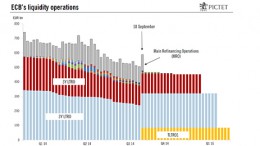
MADRID | The Corner | All markets eyes are set on the ECB’s second offer of cheap four-year loans (TLTRO), which will take place next Thursday and are aimed to revive the eurozone’s battered economy and try to boost lending to SMEs. As a matter of fact, this second round will be important as any decision about launching a QE program will be influenced by how the banks respond to Thursday’s liquidity open bar.