Spanish banks covered €16 billion of failed smaller entities’ bill
SANTANDER | By A. Laso | Spanish banks association’s president is optimistic about weak entities paying back future help packages after they are restructured into the private sector.

SANTANDER | By A. Laso | Spanish banks association’s president is optimistic about weak entities paying back future help packages after they are restructured into the private sector.
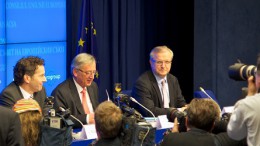
LONDON/MADRID | To compensate the news of a banking bailout limitation, the Eurogroup today may bring up a few tricks: the protection of SMEs’ non-guaranteed deposits of up to €100,000.

MADRID | By Julia Pastor | Car components company CIE Automotive will merge its forging plants in Spain and Lithuania with Indian group Mahindra. The resultant company will be named Mahindra CIE. This strategic alliance will enable CIE to double its current sales of €1.6 million.
SAO PAULO | By Marcus Nunes | This “resumption of growth” view has spread like ‘bush fire’. But why?
MADRID | By Miguel Ángel Rodríguez, analyst at XTB | valenciaplaza.com | Has the Japanese experiment failed? Under the stress of some political pressures, Japan may have rushed into an expansion of its monetary base without all the due protections.

MADRID | By Luis Martí | The German government could also be drawn in as an expropriator of sorts: it is still an issuer of debt at a real yield equally negative for their nationals.

MADRID | The Abengoa-Triton deal values Befesa at an enterprise value of €1,075 million.

MADRID | By JP Marín Arrese | Banks should enforce the sooner the better these EBA guidelines if only to avoid transforming their credit portfolio into real estate heavily undervalued.

MADRID | By Francisco López | In spite of the frequent denials coming from Madrid, though, using that cash–officially it isn’t called a banking rescue but “financial assistance in favourable conditions”–would be a clever thing to do.

MADRID | By Luis Martí | What is worrying is the Bundesbank attitude of permanent and frank opposition to the initiatives of the ECB to overcome the crisis, being against any flexibility and realism that the economy is needing.