
Improvement in German domestic demand could offset China jitters
The German economy continues sound but turbulence coming from emerging markets could impact sharply on Germany’s export-led growth.

The German economy continues sound but turbulence coming from emerging markets could impact sharply on Germany’s export-led growth.

MADRID | July 24, 2015 | By Fernando Barciela | Economist, businessman and former minister at several Spanish socialist cabinets between 1982 and 1993, Carlos Solchaga praises the big steps taken by the Spanish labour reform –the main of which he claims were made in the years ‘93 and ‘94, while he was a member of the government. This is the first part of our conversation.

MADRID | July 5, 2014 | By Fernando González Urbaneja | It’s been one of the costs of the crisis: an internal wage devaluation. Over the last year and half of the economic recovery, with the country’ GDP growing more than one percentage point above the EU average, Spain managed to create almost a million new jobs, almost one-third of what was lost.

The Corner | March 17, 2015 | EU wide inflation figures are expected to be in negative territory for the fourth consecutive month. Elsewhere in Europe, data on employment and economic sentiment are expected to show slight improvement for the month of February.

The Corner | March 6, 2015 | In yet more positive news for the Spanish economy, influential foundation FUNCAS has revised its growth projections upwards for 2015 to 3%. Increased consumption and an improvement in the construction sector are the chief reasons for the upward trend.

The Corner | March 3, 2015 | Retail sales in Germany beat expectations in January: they rose by 5.3% instead of the forecast 3.0%, and up from the December’s upwardly revised 4.8% rise. Spanish and German consumers are seemingly much happier about the state of the economy.

By UBS analysts | As the US economic recovery completes its fifth year, direct policy stimulus is no longer being applied, but the economy is poised to move ahead on its own self-generating momentum. Real GDP growth is expected at 2.9% in 2015 and 2.8% in 2016. Less slack in the labor market along with accelerating labor demand should soon be accompanied by somewhat faster wage gains to boost household incomes, confidence and spending. A rising industrial capacity utilization rate should help trigger more sustained gains in capex. And a falling residential rental vacancy rate should further stimulate rents and residential construction.

MADRID | By Fernando G. Urbaneja | There is a consensus amongst Spanish economists, who are forecasting a growth in GDP of 1.3% in 2014 and 2% in 2015. The Government shares this view and, on this basis, has already outlined the draft of next year’s budget. It believes that the “recovery and increased employment” phase is already under way, and in fact, that Spain is showing better indexes than the Euro zone average.
LONDON | By Rajiv Setia and Anshul Pradhan at Barclays | Developed rates markets rallied globally over the past week, led by the long end, largely in response to the across-the-board underperformance of risk-assets. Figure 1 shows changes in ED-implied rates on the day of the September FOMC meeting, as well as the change from pre-FOMC levels to now.
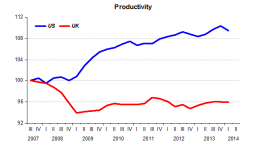
SAO PAULO | By Marcus Nunes via Historinhas | NGDP and RGDP trends are rather similar in both countries. The main question is: Why is the UK´s labor market so much more exuberant?