
Today’s market chatter in Spain
MADRID | By Jaime Santisteban | Higher capital requirements for US banks, aggressive moves in the airline industry and much more…

MADRID | By Jaime Santisteban | Higher capital requirements for US banks, aggressive moves in the airline industry and much more…
MADRID | By Luis Arroyo | In the last two years, the FED did not meet the inflation target (the same as the ECB, although the latter has a commitment of 2% tops), which has grown at a slower pace than announced –as we can see in the chart above (by Ryan Avent at The Economist).
ANIMAL SPIRITS IN WASHINGTON | By Pablo Pardo | Throughout the last two years, bank regulators have identified a number of increasingly exotic assets in the already-full-of-exotic assets banks’ portfolios. For instance, some institutions are accumulating massive amounts of Credit Default Swaps (CDS). At a time when debt spreads are not just falling, but crashing, what is the logic to hedge in such manner? The short answer is: stress tests.
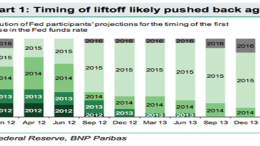
SAO PAULO | By Marcus Nunes | That’s the image that came to mind when I saw this chart from Bank Paribas that Binyamin Appelbaum reproduced in his post [see above].
WASHINGTON | By Pablo Pardo | Does anybody remember where the Standard and Poor’s 500 Index was five years ago? At 666. Since then, the S&P 500 has gone up a whopping 175 percent. The market has defied fiscal cliffs, Republican obstructionism, three rounds of Quantitative Easing, the start of the Fed’s ‘tapering’, the change in Chinese leadership, the euro near-collapse, a nuclear catastrophe in Japan, a wave of revolutions in the Middle East, and even a Russian invasion of Crimea.
SAO PAULO | By Marcus Nunes | That’s plainly absurd. But maybe it’s what you should expect if the Fed narrows down its focus of analysis to a “corner of the room (inflation) which has already been ‘cleaned-out’”.
WASHINGTON | By Pablo Pardo | Federal Reserve’s Beige Book is like a breeze of fresh air for those who think that economic analysis relies too much on data and math. The famous Book is made just by using non-systematic, non-quantitative inputs. Maybe that is not too effective to estimate until the last decimal the future evolution of the GDP deflator, but it is extremely precise to determine the current state of affairs of the economy.
SAO PAULO | Guest post by Benjamin Cole at Historinhas | No serious democrat contends that obscurantism, opacity and secrecy are handmaidens of good government. Indeed, closed doors are properly and universally regarded as cardinal sins, while transparency and accountability as gateways to working democracies. Yet the public is barred from meetings of the most powerful economic policymaking body in the United States—the Federal Open Market Committee, the decision-making body of the Federal Reserve Board, wherein monetary policy is decided.
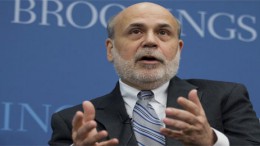
SAO PAOLO | By Marcus Nunes | Let´s see. For his memoirs as Fed Chairman Greenspan pocketed 8 million from Penguin. Given PCE inflation Bernanke should get at least 9 million from the same editor. But Bernanke´s book is worth more. Greenspan presided over the Great Moderation. Great Moderations don´t give rise to dramas as does a Great Recession (Lesser Depression).
SAO PAOLO | By Marcus Nunes | In his recent post at Econlog Scott Sumner writes “Questions that have no answers”: There are some questions that have no answers. One example is the question: “Was monetary policy too expansionary during the housing boom?” The only sensible answer is “it depends.” It’s not clear what the Fed was trying to do during this period.