
Markets

No Picture

Peripheral Spreads Should Hold in Well Into Year-end (Barclays)

LONDON | By Cagdas Aksu | The Fed’s dovish surprise in the September FOMC meeting should benefit core peripheral spreads for several reasons. First, we note that even amid all the Fed tapering concerns since May, core periphery spreads versus Germany have behaved very well and never underperformed much, despite the sell-offs seen in other riskier asset classes, such as emerging markets and certain segments of credits markets.


markets merkel

Markets Don’t Open Champagne for Merkel

MADRID | By Francisco López | The landslide victory of Angela Merkel in the German elections has had a vast echo in the media around the world and yet a relatively small impact on the markets, which had already seen the Chancellor’s triumph coming and opted for collecting profits after several days of strong gains.


pmi euro japan

In a Glimpse- PMI and Central Bank Actions

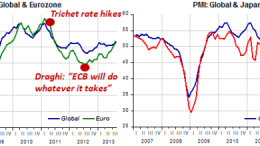
SAO PAULO | By Marcus Nunes | Markit´s PMI survey is a favorite of central banks and financial institutions. The panel below shows both the global (comprised of 32 countries) and the Eurozone and Japan PMI´s. Trichet´s rate increase ‘folly’ of April and June 2011 as well as Draghi´s “ECB will do whatever it takes” of July 2012 are marked. So is the “Abe effect” in Japan.


No Picture

US Interest Rates and the New Conundrum

LONDON | By Michael Gavin at Barclays | Today, we mainly remember the ‘Greenspan conundrum’ as a puzzle about the level of US interest rates in the several years leading up to the 2007-08 financial crisis. But the original conundrum was as much about the insensitivity of long-term interest rates to the tightening of monetary that began in mid-2004 as it was about the level of interest rates.


fisher

Can Stanley Fisher sit on Bernanke’s chair?

THE CORNER’S FRIDAY WRAP-UP | Buffet says that only Bernanke should take the Fed’s seat and Janet Yallen seems to be the best positioned candidate. But what if this is all a Fed’s manoeuvre? 


forex

Forex turnover results 2013 – or why you should worry

HAMBURG | By Dr. Beate Reszat | The BIS Triennial Central Bank Survey of foreign exchange turnover makes a fascinating read. First of all, there is the rise in turnover volume: $5.3 trillion. Per day. By comparison: World exports in 2011 (the latest available number) were about $17.8 trillion. Per annum. Second, there is the number of currencies traded which, as the following list shows, has increased markedly. The Mexican peso and Chinese renminbi are even found among the top 10 most traded currencies now.


No Picture

Fed’s Taper Off: Doves Prevail, Markets React

NEW YORK | By Ana Fuentes | Fed officials surprised on Wednesday by deciding not to start trimming the $85 billion-a-month bond-buying program. “We can’t let market expectations dictate our policy actions,” Ben Bernake said, explaining that unemployment in the U.S. has not improved enough to cut stimulus. Reactions were immediate.


volatility

Whatever happened to September volatility?

By Barry Knapp (Barclays) | There is a key difference from the surprisingly low volatility Septembers in 2009-12. In that period, the Fed was either buying assets or had pre-announced a new program; this year, it is preparing to weaken the portfolio balance effect. In our view, for equities to overcome unfavorable seasonality and another round of fiscal concerns, fundamentals, which have been mediocre for over a year, due primarily to weakening global and soft domestic growth, will have to improve considerably.


Chinatapering

How Fed’s Tapering Will Affect China

BEIJING | By Hong Hao via Caixin Magazine | The answers to how the Fed’s tapering will impact the market seem a little too obvious: the consensus is that tapering will jolt market interest rates substantially higher and thus provide headwinds for the market. Further, there is the belief that given China’s closed capital accounts, tapering will be inconsequential for its markets. I beg to differ.