

In Europe

No Picture

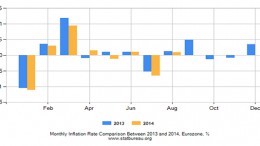
Inflation: A monetary cancer metastasizes in Europe

VIENNA | By Keith Weiner via Truman Factor | The European Central Bank again cut the interest rates it controls. Notably, the deposit rate was moved deeper into negative territory. It is now -0.2% (minus 20 basis points, that is not a typo). The ECB says it’s trying to nudge prices higher, but it’s actually feeding the cancer of falling interest. The linked article above, like most, is focused on the quantity of euros and the presumed direct relationship to price. The following bit of editorializing from that article is uncontroversial in Frankfurt, London, New York, Mumbai, or Shanghai.
No Picture

Does Greece need a third programme?

By Jens Bastian via MacroPolis | During his visit to Berlin this week, Prime Minister Antonis Samaras repeatedly emphasised that Greece does not require a third financial support programme. In his conversation with Chancellor Angela Merkel he highlighted that the Greek sovereign was able to successfully return to international bond markets in April after a three-year forced hiatus.


No Picture

Euro area: A chartbook of key economic indicators

LONDON | The Corner | According to experts at Barclays, the significant depreciation of EUR/USD (Fig 1) has been a key data event in the past few months. However, the sharp fall in oil prices has partially offset this positive effect on inflation, which has remained at 0.4% y/y in August. The inflation data remain crucial for the ECB, which has repeatedly emphasised that there is unanimous commitment to use all available tools to prevent a period of prolonged low inflation. We now expect QE on sovereign bonds, most likely by Q1 15.


No Picture

Change of pace in Europe: Spain, Portugal, Ireland and Belgium will lead growth between 2015 and 2016

MADRID | By Julia Pastor | ECB’s Mario Draghi brought put the bleak panorama that the Eurozone’s economy is facing on the table, and we saw it again reflected in the not-so-promising September manufacturing PMI. The index came in at 50.5 compared to 50.7 in the prior month, whereas EZ Services PMI accelerated at 52.8 for September versus 53.1 in August. Even the composite index plummeted to its lowest fee in the last nine months and reached 52.3. In Germany, both manufacturing and services indexes have also decreased; while in France only manufacturing improved, although it is still contracting.


No Picture

Fresh doubts about economic cohesion at the European parliament

BRUSSELS | By Alexandre Mato | The EU parliament needs to reinforce its economic policy co-ordination to achieve a common fiscal consolidation between Member States. These are the main tasks facing Jean-Claude Junker and his team in the months ahead. EU policymakers must now chart a cohesive strategy to combat growing policy divergences in Eurozone member states. 


inflation eurozone

Is low inflation to blame for Eurozone woes?

MADRID | J.P. Marín Arrese | Eurozone policy makers depict sluggish growth and low inflation as two sides of the same coin. This approach fails to grasp the subtle distinction between the two. Muted inflation undoubtedly stems from faltering demand linked to current stagnation. Yet it also reflects the ongoing real adjustment. Reviling it as the main wrongdoer, rather than treating it as a collateral victim, utterly misses the point in enforcing effective policy.


draghi

Why ABS drive will fail, Barclays reckons

MADRID | By Alberto Vigil at Barclays | The ABS purchases by the European Central Bank will not work basically because it is necessary for a regulatory change that does not penalise (in capital terms) either banks or insurance companies who have those securities. That is, if the ECB’s intention is to increase the amount of credit in the real economy, then it should have two specific goals: first, spreading the risk that banks assume when they provide credit; second, reducing banks’ costs of financing.


Captura de pantalla 2014 09 22 a las 12.09.11

UPDATED: EU confidence: a rough Autumn ahead?

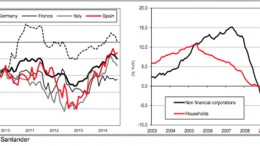
MADRID | The Corner | UPDATE: Consumer confidence fell to minus 11.4 in September from minus 10.0 in August. Economists had expected a fall to minus 10.5. In major countries, Spanish household consumption is very slowly gaining traction, while France’s economy loses momentum -expect very different behavior in  private consumption patterns in the future, Santander analysts commented on Monday. On the left: eurozone’s consumer confidence since 2002; on the right: EZ credit lending to the private sector since 2002.