
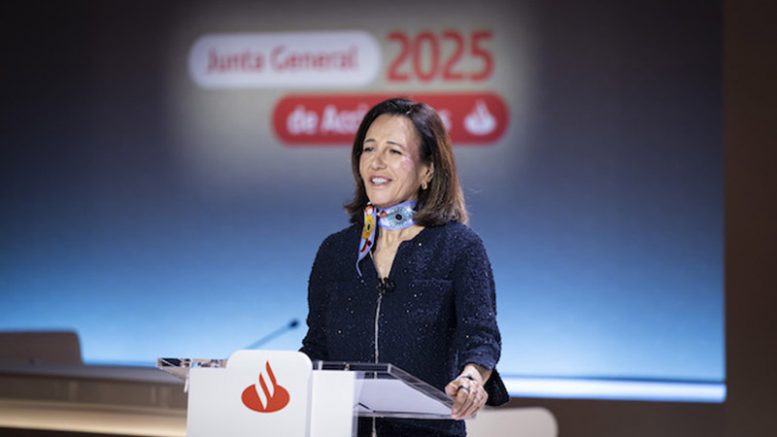
“If you are not in the U.S., you cannot aspire to be a global bank,” stated Ana Botín, Executive Chair of Banco Santander, explaining the acquisition of Webster for $12.2 billion—an all-stock transaction. She described the move as a “growth operation” that will “allow us to increase earnings by 7% and positions us to be one of the most competitive banks in the U.S., with the expectation of reaching an 18% ROTE by 2028 because it gives us the scale necessary to compete, much like TSB in the UK… The goal is to be the most profitable bank in each of our markets, and that will be achieved in the U.S. by 2028.”
Botín estimates the transaction will yield a 15% return, “significantly higher than a share buyback” (a €5 billion buyback program begins tomorrow), with $800 million in synergies and the integration of all its U.S. businesses (Openbank has attracted $8 billion there over the last 15 months).
With this deal, Santander adds 2 million commercial banking customers to the 180 million customers the bank reported at the end of the 2025 fiscal year, which closed with a profit of €14.101 billion.
In 2025, Santander achieved a RoTE of 16.3% and a CET1 ratio of 13.5%, with an efficiency ratio of 41.2% and a 17% increase in Earnings Per Share (EPS).
Analysts at Jefferies say…
| The acquisition of Webster today is the last M&A act from SAN for the foreseeable years, and is aimed at addressing SAN’s sub-scale in the US. While the decision to allocate more capital to the US is unlikely to be taken easily by the market, we think that the guided impacts of the deal and the valuation are not overly aggressive. With capital fixed, the UK & the US being addressed through M&A and 80% of the BS now in hard currencies, we remain buyers. |
| Hat trick of transactions in under 1 year. The acquisition of Webster in the US today closes a series of 3 transactions announced by Santander in less than 12m (Santander Polska sale, TSB and Webster acquisition), with the ultimate goal of addressing the lack of scale the company had in the UK and the US. Santander expects these transactions to contribute to a 2028 Group RoTE >20%. We believe the guided financial impacts from the Webster acquisition are not overly aggressive, with guided synergies in line with previous deals (and not assuming any benefit from funding or revenue synergies), albeit guided restructuring charges on the lighter side. The total consideration Santander is paying, 12.2bn USD (75 USD/share), a 14% premium to undisturbed price, implies a 2x spot P/TNAV, or 10x ’28e PE multiple for Webster, which looks fair to us. With the deal being structured 65%/35% in cash/shares, the capital impact at 140bps is manageable, and does not pose risks to the capital distributions targets previously announced, albeit will temporarily take Santander’s CET1% slightly below the 13% target.The challenge? What we believe could be tricky is that SAN now has to deliver on the simultaneous integrations of both TSB and Webster, while also overseeing the One Transformation Program in the Rest of the Group, albeit we note that both TSB and SAN should be relatively lower execution risk transactions.Guided synergies not overly aggressive; no benefit from funding/revenue synergies assumed. We believe the cost synergies guided for (800m USD, equivalent to 18% of the combined cost base) are realistic. These include 480m USD of HQ& overhead cost saves, 280m USD of tech savings and 35m USD of other cost saves. We note these do not include any benefit from funding synergies (which we believe could be unlocked) or any benefit from revenue synergies. Restructuring charges at 1x cost synergies are a touch lighter than seen in previous deals (and indeed lower than in the UK deal, at 1.3x cost synergies). The Webster transaction is expected to close in 2H26.Valuation seems fair.The transaction values Webster at 10x 2028 PE (6.8x 2028 P/E) pre(post)-synergies and 2.0x Q425 P/TBV, with an expected return on invested capital for Santander of c.15% and c.7-8% earnings per share accretion by 2028. |


