
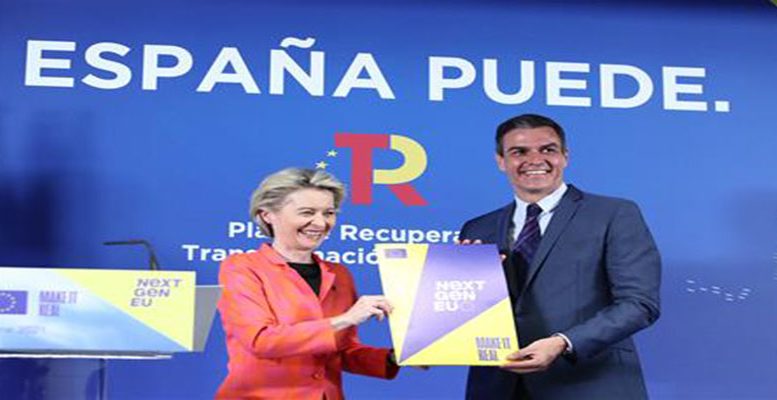
The Government has already agreed with Brussels on a new scenario of milestones and targets so that Spain can access all the remaining direct aid from the Recovery Plan. What is at stake is the way to capture and execute the nearly €24.7 billion in outstanding non-reimbursable funds before the opportunity expires in August of next year.
After several weeks of intense negotiations with the European Commission, the Ministry of Economy has now finalized the latest of the addenda to the recovery plan, the seventh. The previous one, in September, was related to the DANA (isolated high-level depression). The new document, which is being analyzed today for approval by the Council of Ministers, includes an update and expansion of the Recovery Plan.
The Government has set a target of reaching one hundred percent of the direct aid reserved for it by the EU, amounting to €79.854 billion. To date, €55.092 billion have been obtained, nearly 70% of the total. These are transfers that do not require repayment and represent a great opportunity for the modernization of the country. However, each reimbursement remains conditional on technical verifications from Brussels, which have already caused delays.
The materialization of the aid now depends on two things: having enough time to execute the projects and the Government approving the committed reforms in an environment of parliamentary weakness. Regarding the first aspect, one of the objectives of the addendum is to provide continuity to investment projects beyond August 2026, which is when the execution deadline ends. There is time until December 2026 to receive the last disbursement.
To achieve this, milestones are being extended, procedures simplified, formalities streamlined, and administrative burdens reduced, in line with the European Commission’s new strategy. There are 337 pending milestones whose simplification has been under negotiation for weeks.
The idea is that the new addendum will serve as the basis for requesting one or two more disbursements before the funds run out. Spain is behind schedule in these requests. According to the initial timeline, it should have received 94% of the money before the end of the year.
The counterpart to the aid consists of the adoption of reforms, which is the most thorny element for the Government. In the new negotiation, Brussels has agreed that a part of the pending measures, previously included in nine laws, can be converted into lower-ranking norms that do not necessarily have to pass through Parliament (the Congress). They can proceed in the form of Royal Decrees or Ministerial Orders that the Government still needs to specify. On the other hand, laws such as the Industry Law or the Transparency Law, which regulates lobbies, will continue to force the Government to confront a Parliament that it no longer controls.


