
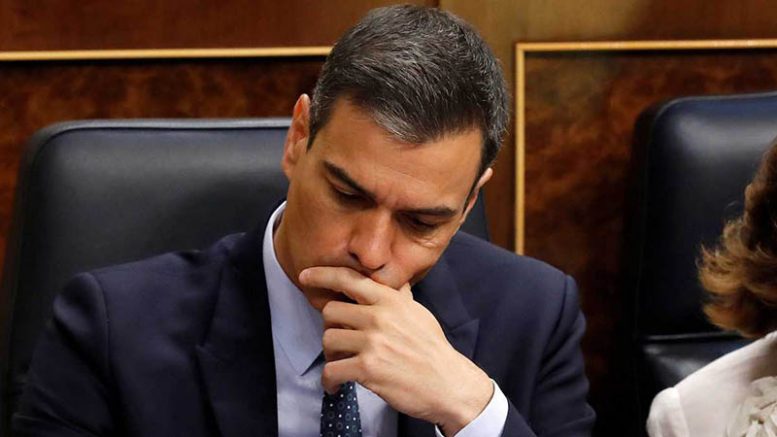
The Government suffered another defeat in Congress yesterday, proving once again that it lacks a parliamentary majority even to carry out the minimal legislative activity required to survive. The Executive failed, for the second time, to pass what it calls the “social shield” due to the refusal of Junts (along with the PP and Vox) to accept the extension established during the Covid era, which prevents property owners from evicting tenants who stop paying and declare themselves “vulnerable.”
A so-called “social shield” that the Government is building at the expense of rental property owners, who can be sued by their tenants if they pressure them to leave the flat—for example, by cutting off utilities (water, electricity…). Consequently, in addition to being unable to collect rent, owners must cover the expenses of the “inkiocupa” (squatting tenants). It is estimated that there are approximately 60,000 apartments in this situation, which, from the Government’s perspective, does not justify such social alarm, given that it represents a tiny percentage of the existing housing stock. What the Government fails to explain is that the fear of finding oneself in this situation has shrunk the supply of rental apartments, further exacerbating the housing problem. Furthermore, owners have tightened rental requirements (demanding permanent contracts, guarantees, etc.) in an attempt to prevent tenants from being able to declare themselves “vulnerable” (for example, if they have small children).
The plenary session of Parliament made it clear that Sánchez’s PSOE lacks a parliamentary majority to sustain its governing efforts. Of the four decrees submitted for a vote—a fact that, in itself, demonstrates a commitment to a political style based on abuse, given that decree-laws require a justification of “urgency”—the Executive only managed to pass two: the one providing aid to the victims of the train accidents in Adamuz (Córdoba) and Gelida (Barcelona), and the one allowing for the revaluation of pensions. It lost two other votes: the one Sánchez calls the “social shield,” and the one that would have given the government the green light to intervene in pricing during “emergency” situations to curb price gouging resulting from unforeseen events—as seen with airfare prices following the rail accidents.
Given the situation, it seems impossible for the Government to pass the budgets it has committed to presenting before the end of this first semester. This is a constitutional obligation—to present the budgets before the end of the year—which the Government has systematically failed to meet in order to avoid parliamentary defeat. Consequently, in 2026, Spain is still operating with 2023 budgets that were approved in 2022—that is, during the previous legislature.


