
Paolo Zanghieri
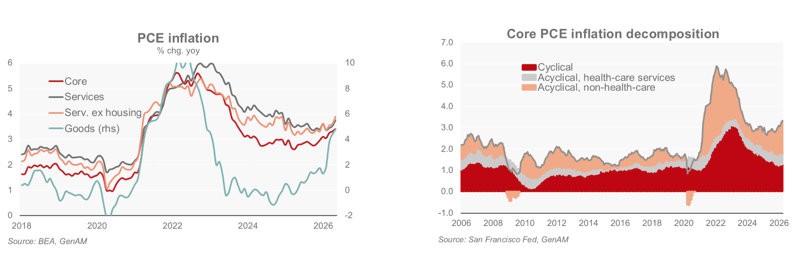
Inflation remains the main constraint for the Federal Reserve, but the factors driving it are likely to matter more than the headline figure. Core PCE stood at 3.4 per cent in May and could remain at uncomfortable levels in the short term, although we expect it to peak shortly and fall to 3.1 per cent year-on-year in the fourth quarter, 0.1 percentage points below the Federal Open Market Committee’s (FOMC) median projection.
If oil prices remain close to pre-conflict levels, the feared second-round effects on core inflation should be muted, whilst survey-based inflation expectations should partially reverse as petrol prices fall.
The sharp rise in goods prices has been a key driver of the recent surge in inflation. Tariffs played a significant role in pushing up the price level, but their impact on annual inflation has probably already peaked and should moderate in the coming months. Nor do we expect the forthcoming tariff restructuring to increase the overall rate. More recently, the tariff-driven momentum has gradually been replaced by the AI boom. The surge in memory chip prices between the fourth quarter of 2025 and the first quarter of 2026 is feeding through to inflation in software and computer accessories, which rose from 4.4 per cent year-on-year in December to 13.9 per cent in May. This component contributed around 70 basis points to annual core inflation in April and May. Recent data show that chip prices are stabilising, and we expect this component of inflation to fall rapidly towards the end of the year. Nevertheless, as demonstrated by Apple’s recent 20 per cent price increase on certain products, the pass-through to retail inflation could be protracted. The sharp rise in technology prices may reflect a structural shift coinciding with supply bottlenecks, making it difficult to determine whether a more restrictive monetary policy would be the appropriate response.

Inflation in services remains the main domestic obstacle to a clearer disinflationary path, but the signs are beginning to look less worrying. Rent growth is moderating: the Zillow index, a key leading indicator for official rents, rose by 1.9 per cent year-on-year in April, approximately one percentage point less than a year ago. House price growth has slowed even further, falling from 3.3 per cent year-on-year in March last year to 0.7 per cent this March, and this should feed through to rents with a lag of between six and nine months. High mortgage rates are a significant factor in this adjustment and are unlikely to fall rapidly, with the 30-year rate still around 6.5% after fluctuating between 6% and 7% over the past two years.
Outside the housing sector, inflation in services reached 3.9 per cent year-on-year, with bouts of volatility in specific sectors, such as airfares driven by fuel prices or brokerage fees linked to movements in the S&P 500. Labour costs are a significant structural factor, and looking ahead, these are unlikely to generate the genuine demand-driven pressure that should be of greatest concern to the Federal Reserve.
More generally, indicators from the Federal Reserve Bank of San Francisco suggest that core inflation remains elevated, primarily due to factors with limited relevance to the economic cycle, including tariffs and oil prices. Once these factors subside — and provided there are no further adverse supply shocks — inflation should continue to moderate gradually.