
World economy

spain FDI

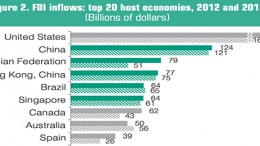
Spain, largest European FDI receiver in 2013

MADRID | The Corner | As global confidence revives and money is in the air, more deals are expected. Foreign direct investment (FDI) inflows, which grew year-on-year to $1.45tn in 2013, will rise to $1.6tn in 2014, $1.75tn in 2015 and $1.85 tn in 2016, according to the last U.N. economic think tank UNCTAD report. Spain is one of the EU’s most benefitted recipients attracting $39 billion from vulture funds, venture capital, billionaire families, pension plans or even sovereign funds.


No Picture

Emerging economies show weakness signs

MADRID | By Francisco López | Ben Bernanke’s warning about a posible withdrawal of Fed monetary stimulus a year ago prompted a notable rise of premium risks and general drops in global stock markets, but deeper in emerging economies. And it indeed hit the so-called BIITS (Brazil, Indonesia, India, Turkey and South Africa). Today, stocks have recovered and stand at levels prior to the taper shock, although some collateral damages are there.


No Picture

Halting QE= Active monetary asphyxiation?

NEW YORK | By Benjamin Cole at Historinhas |  The recent historical and empirical record strongly suggests central bank quantitative easing (QE) works. The riddle is whether both the Japan and U.S. economies will slip into stagnation again without QE, as long as there is a global glut of capital holding down interest rates, and inflation is dead—or even if inflation is near 2 percent on the PCE deflator, the putative Fed target. The riddle might even be reframed: When central banks do not conduct QE, are they actively engaged in monetary asphyxiation?


No Picture

Stage two of the Japan macro trade

LONDON | By Barclays analysts | The Japan macro trade has been off the radar in 2014, but that should change (for better or worse) in the coming few months. US yields have likely bottomed, while the effect of Japan’s VAT increase appearsmanageable. More important, PM Abe has unveiled more details of his 3rd Arrow (the structuralreform program), including a long-anticipated cut in the corporate tax rate.


No Picture

Special Issue: Nigeria, the giant against the ropes (II)

MADRID | By Donato Ndongo-Bidyogo | For the last weeks Nigeria has made big headlines due to the kidnapping of more than 200 girls by the Islamist terrorist group Boko Haram. Most of the victims remain missing, as the first African economy faces systemic issues that compromise next year elections.


Argentina's default 2

Argentina and the economic crisis cliff

Amid an important devaluation of its currency, and with its central bank rapidly losing reserves, Argentina is entering a critical stage as it attempts to avoid a new economic crisis. In November 2013, Argentine President Cristina Fernandez de Kirchner decided to limit her public appearances and delegate to new ministers. Economy Minister Axel Kicilloff and Chief Minister Jorge Capitanich were tasked with revising the economic course of a government that is starting to show weaknesses. Today, not only is the Argentine public worried, but so too is the international community.


No Picture

Labour market as a guide to the monetary policy

MADRID | By Luis Arroyo | Experts at Afi made an analysis of the US’ labour market to forecast a possible turn in the economic policy. The answer is that such market is yet far from standardization. We can see three different moments according to the standard deviation in the chart above.


No Picture

Taobao now sells tickets to outer space

By Ray Kwong | After Virgin Galactic hurt the feelings of the Chinese people earlier this year by banning Chinese nationals from its space flights, prospects looked dismal for mainland space freaks. Perhaps that’s why 305 buyers signed up within minutes last Thursday when Taobao (yes, the online bazaar where you can truly buy anything) opened up registration for trips to outer space with the Dutch firm Space Expedition Corp. (SXC).