
In this context, growth ceases to be merely an economic objective and becomes the main determinant of European fiscal sustainability.
By Morgan Stanley
Europe is entering a new fiscal regime in which an ageing population, rising defence spending and higher borrowing costs are coming up against increasingly tight budgets. Although these factors are well known, their combination significantly alters the region’s fiscal outlook and makes economic growth the key variable in determining the sustainability of public finances.
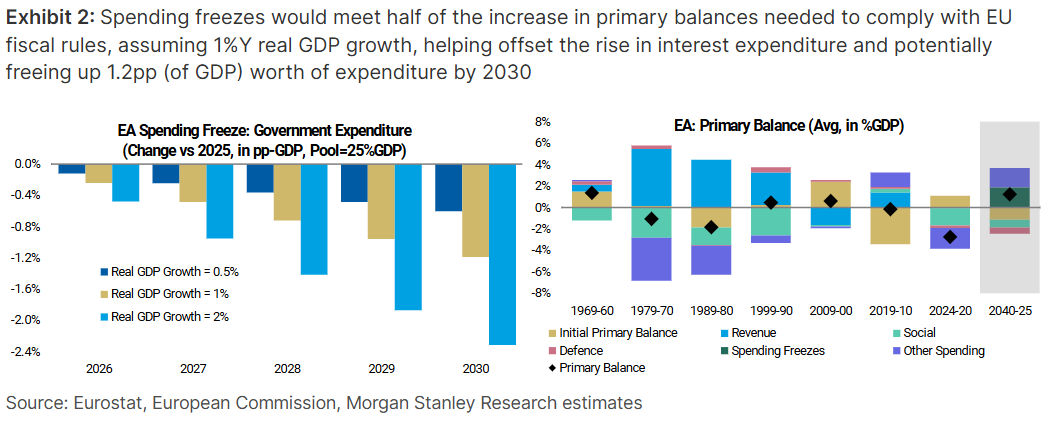
Over recent decades, Europe benefited from strong fiscal tailwinds thanks to economic growth, falling defence spending and a structural decline in interest rates, which allowed for a significant expansion of social spending without causing significant concern in the markets. However, today social benefits already account for 46 per cent of public expenditure in the Eurozone, whilst investment accounts for a mere 6.9 per cent, which limits budgetary flexibility. Looking ahead to 2040, an ageing population, military spending and interest payments could add around 3 percentage points of GDP in additional expenditure in most European countries and more than 5 percentage points in Spain and Portugal.
Prioritising economic growth
Given this situation,the solution does not appear to lie in a return to aggressive austerity, as excessive consolidation could harm growth and worsen long-term fiscal sustainability. Instead, the most realistic strategy would be to prioritise economic growth.
In fact, a combination of moderate budgetary discipline and 2 per cent real growth would generatesufficient fiscal space to comply with European fiscal rules without resorting to sharp tax rises or real spending cuts.
In this context, growth ceases to be merely an economic objective and becomes the main determinant of European fiscal sustainability.
For the markets, this implies a preference for policies that gradually reduce the need to issue debt without harming growth. At sectoral level, Aerospace and Defence emerges as the main beneficiary of the structural shift in spending priorities, whilst pension and savings reforms could benefit the Financial sector and contribute to the development of European capital markets.