

Analysis by Karsten Junius
Higher oil prices are taking their toll on the eurozone’s trade balance. In March, the surplus fell by €3 billion compared with February and by €26 billion compared with March last year. Relatively weak exports in the eurozone’s main export sectors—machinery and vehicles, as well as chemicals and related products—also contributed to the decline in the trade surplus.
The persistence of high commodity prices suggests that imports will remain high in the coming months. Conversely, exports are unlikely to rebound in the short term, as the fall in the Purchasing Managers’ Index (PMI) figures published this week points to lower demand for European exports.
The war in Iran and the closure of the Strait of Hormuz are taking their toll on the eurozone’s foreign trade. Compared with March last year, exports fell by 5.5%, whilst imports rose by 4.4% (Chart 1). As a result, the trade surplus fell to €7.8 billion, down from €34.1 billion a year earlier.
This is partly due to rising oil prices, which pushed up energy imports by €10 billion compared with February and by €3 billion compared with March 2025.
Even more worrying, the eurozone’s main export sectors are showing signs of weakness. Machinery and vehicles, which account for 38% of all exports, have stopped growing, whilst imports in the sector continue to rise, reducing its trade surplus to its lowest level since 2022. The trade surplus in chemicals and related products, which account for 20% of exports, fell even below its 2022 level.
Exhibit 1: Imports rise and exports fall
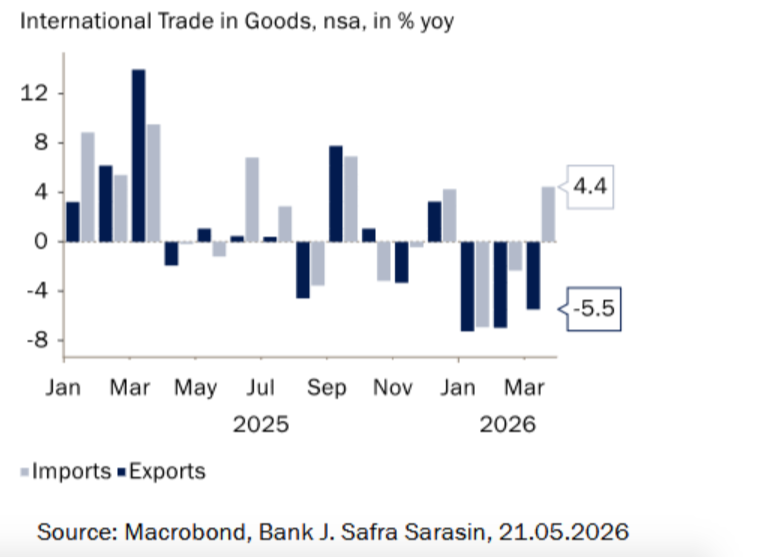
It is true that trade was particularly strong in the first quarter of last year, when companies anticipated the imposition of US tariffs by stockpiling imported goods. However, this does not make it likely that the trade surplus will improve in the coming months. High commodity prices will prevent this.
Given that commodity prices clearly drive the eurozone’s trade balance, a further slide into negative territory is virtually certain (Chart 2). The main driver of this trend is undoubtedly the higher price of oil, which shows a strong correlation with commodity prices as a whole (Chart 3).

The impact that the trade war initiated by the United States has had on monthly trade patterns is most clearly seen in the seasonally adjusted bilateral trade balances with the main trading partners. The trade surplus with the United States surged last March in anticipation of higher tariffs, whilst it remained relatively stable with other countries.
The eurozone typically records large surpluses in trade in goods with the United Kingdom, the United States and Switzerland, whilst maintaining a significant deficit with China. We note that the surplus with the United States has decreased compared with 2025 and 2024, but remains close to the levels observed between 2020 and 2023. Trade with Russia has recently played a merely marginal role.
This week, the European Parliament has approved the trade agreement between the EU and the United States that was reached last year. Various political and trade initiatives adopted by the United States had contributed to repeated delays in its processing.
The agreement stipulates that the US will be able to export goods to the EU at 0% tariffs, whilst European goods will be subject to maximum tariffs of 15% when entering the US market. The pact could provide a more stable environment for bilateral trade.
However, exporters are likely to bear in mind that the geopolitical environment remains highly volatile, which could limit the positive impact of the agreement in the short term.
To end on a positive note, we note that neither global nor European trade has collapsed during the recent trade war. Global trade volumes and trade values may be lagging behind global GDP growth, but they continue to expand.
The eurozone, however, has benefited relatively little from this trend. In line with its virtually stagnant GDP growth, its exports and imports have shown no significant progress over the last three years.


