

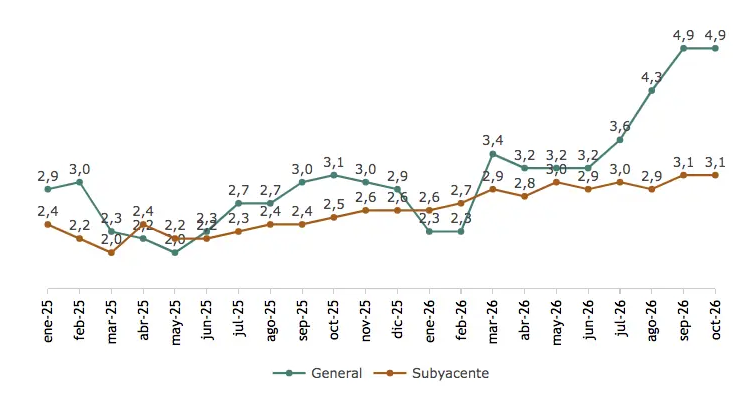
Inflation held steady in October. The Consumer Price Index (CPI) placed its year-on-year rate at 4.9%, according to data released by the National Statistics Institute (INE), which cites falling fuel prices as one of the main drivers.
Nevertheless, it remains the highest rate since February 2023.
In detail, the groups that stood out for their downward pressure include food and non-alcoholic beverages, which placed their annual rate at 2.4%—three-tenths of a percentage point below last month’s figure—due, among other factors, to price increases for fruit and nuts being smaller than in October 2025.
Clothing and footwear also contributed, with its annual variation dropping by three-tenths to 1.8%, a decline explained by prices rising less than in October of last year at the start of the autumn-winter season. Transport followed suit, posting a rate of 10.3%—two-tenths lower than the previous month—driven by lower prices for fuels and lubricants for personal vehicles.
Meanwhile, groups exerting upward pressure include housing, whose annual rate rose by four-tenths to 7.6% due to gas price increases exceeding those recorded in October 2025. Recreation, sport, and culture also saw its annual rate rise by five-tenths to 4.1%, as package holiday prices fell to a lesser extent than in October of last year.
By Autonomous Community, inflation registered positive annual rates across all regions. Castile and León, Castilla-La Mancha, and Galicia posted the highest increases (5.3%), while Andalusia recorded the lowest (4.4%).
For its part, the core inflation rate—the general index excluding unprocessed food and energy products—remained unchanged at 3.1%, the highest level since March 2024.


