
By Martin Wolburg
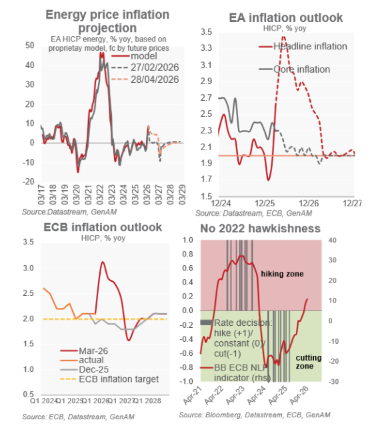
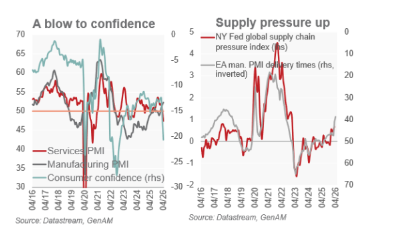
Just as signs of a recovery in economic activity were beginning to emerge, the conflict with Iran has started to weigh on the eurozone economy. Confidence indicators deteriorated significantly in April: the composite PMI fell below the expansion threshold to 48.6, and consumer confidence dropped to its lowest level since the start of the pandemic. Rising energy prices are eroding real incomes, and inflation accelerated from 1.9% year-on-year in February to 3% year-on-year in April. Investment is also likely to weaken considerably. Political uncertainty has increased markedly, and the latest Bank Lending Survey points to a sharp decline in demand for investment-related loans.
The outlook now depends on how the conflict unfolds; specifically, on when the Strait of Hormuz reopens fully. Under our baseline scenario, which assumes a timely reopening, inflation will peak in the second quarter and return to more normal levels within roughly a year. If the Strait remains closed for longer, supply pressures would intensify and amplify the loss of output caused by the war. We expect the Strait of Hormuz to reopen in due course and for activity to recover following a dip in the second quarter. Following disappointing GDP growth of 0.1% quarter-on-quarter in the first quarter, we forecast annual growth of 0.8% in 2026 and 1.1% in 2027, with war-related risks skewed to the downside.
The ECB, facing a possible rate cut
The ECB has shifted towards a more restrictive stance on monetary policy. The ECB considers that the rise in inflation will be short-lived in its baseline scenario, but President Lagarde noted in March that even a brief overshoot in inflation could justify a prudent adjustment to interest rates to keep inflation expectations anchored. Since then, Governing Council members have adopted a more measured stance: taking their time, remaining attentive to the data and monitoring second-round effects. Price-setting indicators have consolidated, but not sufficiently to suggest a widespread rise in underlying inflationary pressures, and wage growth is expected to remain subdued. Weaker activity and the risk that supply pressures could amplify adverse factors also argue against a rate hike. We see limited fundamental need for tightening, although the ECB’s post-pandemic lesson could tilt it towards a more decisive stance.