Driven not only by decarbonisation, but also by geopolitical fragmentation, state intervention and the race for clean technologies, the transition towards electrification is complex and non-linear.
Rosa Duce, CIO of Deutsche Bank Spain, explains: “In this new era of electricity, high levels of investment have already profoundly changed the mix of supply and distribution: the evolution of clean energy from a subsidised niche to becoming an essential, mainstream investment is just one example of this.”
According to data from the IEA (International Energy Agency), in 2025, the world invested $3.3 Bn in energy systems, with around $2.2 Bn allocated to clean energy categories. But what is also striking is that, again according to the IEA, investment in the electricity system totalled $1.5 billion in 2025, almost 50 per cent more than investment in fossil fuel supply. In the emerging ‘electricity supercycle’, demand for and investment in electricity are growing faster than total energy demand, as end-users shift from the direct combustion of fossil fuels to electrified alternatives. Europe provides a particularly clear illustration of this dynamic: here, investment in clean energy supply outstrips investment in fossil fuel supply by a ratio of 3.5 to 1.
The electrification process continues, and funding gaps remain. The IEA emphasises that global investment in electricity grids must increase significantly to approach parity with investment in generation, to ensure that electricity systems can absorb and integrate rapidly growing shares of renewables. Furthermore, the distribution of investment remains uneven. Africa, home to around 20 per cent of the world’s population, receives only around 2 per cent of investment in clean energy. Nevertheless, fundamental shifts have already taken place in the electricity supply mix. Renewables are forecast to overtake coal as the world’s largest source of electricity generation by mid-2026.
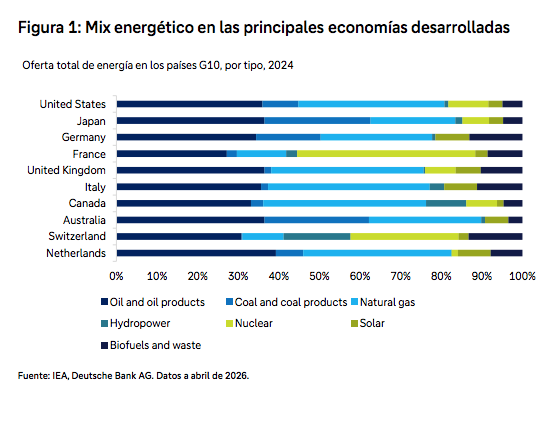
In China, coal still accounts for approximately 60 per cent of generation, but low-carbon sources already provide nearly a third of the electricity, and virtually all net growth in electricity demand will be met by renewables, led by solar, wind and hydropower. In the EU, wind and solar power accounted for 30 per cent of electricity generation in 2025, overtaking fossil fuels (29 per cent) for the first time. In the United States, however, progress has been slower in recent years and more dependent on the political context: natural gas accounts for around 40 per cent of generation, renewables for 22–23 per cent and nuclear for around 18 per cent.
The rapid growth in renewable capacity is likely to continue. The IEA expects installed renewable capacity to double between 2025 and 2030. By 2030, around half of global electricity generation is expected to come from renewables and nuclear combined – a level of low-carbon penetration that until recently was considered a long-term aspiration rather than a short-term outcome.
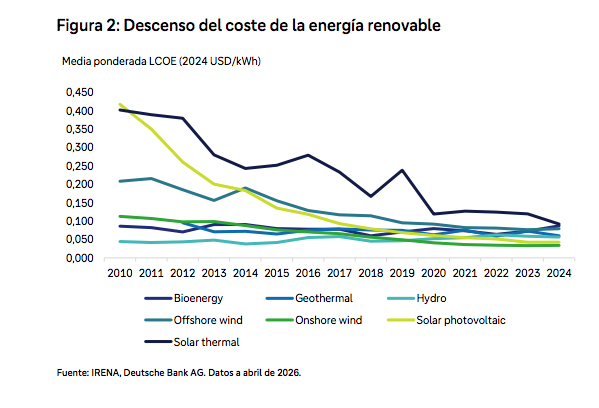
In the years leading up to 2030, electricity demand is forecast to grow approximately 2.5 times faster than total final energy demand, according to the IEA, due to electrification in industry, electric vehicles, buildings, space cooling and, increasingly, data centres. Global EV sales reached 26 per cent of passenger car sales in 2025, up from 21.7 per cent in 2024⁷, and recent geopolitical shocks and their impact on gas prices are now providing further impetus, as discussed later in the report. The energy transition is increasingly being driven by hard economic realities rather than climate policy alone. Sector analysis indicates that solar photovoltaics combined with battery storage is already cost-competitive with coal and gas in several markets. In short, clean energy has moved from being a subsidised niche to becoming part of mainstream investment logic.
Electrification as a geopolitical strategy
Recent conflicts have reminded us of the intrinsic mismatch between dependence on fossil fuels and energy security in an increasingly fragmented world. As a result, there has been extensive debate on how energy policy will be increasingly determined by strategic exposure to geography, supply routes, political risk and cost optimisation, complementing states’ environmental decarbonisation objectives.
Fossil fuels differ from renewables in three geopolitically relevant dimensions. Firstly, as is widely known, reserves are geographically concentrated. Secondly, consumption depends on physical transport via pipelines and maritime routes. Thirdly, as the conflict with Iran has clearly demonstrated, global supply is exposed to a limited number of critical bottlenecks (e.g. the Strait of Hormuz). Some regions are more exposed to these bottlenecks than others. According to the US Energy Information Administration and the International Energy Agency, oil and LNG shipments through the Strait of Hormuz in 2025 continued to be overwhelmingly directed towards Asian markets, with around 80 per cent of crude oil flows and the vast majority of LNG destined for Asia.
Expanding the supply of fossil fuels does not eliminate this vulnerability: it simply shifts exposure between routes and suppliers, reducing but not eliminating the risk associated with bottlenecks.
In debates on energy policy, a distinction is increasingly being drawn between economies that rely on fossil fuel imports but are undergoing structural electrification (so-called ‘electro-states’) and those that continue to rely on the direct combustion of fuels (the ‘petro-states’).
An ‘electro-state’ is characterised by an increasing proportion of total final energy consumption being supplied in the form of electricity rather than through the direct combustion of fuels. In this sense, electrification transforms energy from a traded commodity subject to geopolitical risks into a domestically produced infrastructure service. China represents the clearest example of this model. China remains highly exposed to imported oil and gas, but this exposure has strengthened, rather than weakened, its commitment to electrification and the domestic roll-out of clean energy.
For ‘electric states’, electrification based on renewables appears to be the most rational economic strategy, both in terms of cost competitiveness and economic resilience when hydrocarbon supplies are disrupted, at least as far as price volatility is concerned. However, whilst a high capacity of renewables can reduce volatility, this does not directly translate into lower electricity costs: much will depend on how the wholesale electricity market operates, as its design and regulatory objectives vary widely between countries, and these differences substantially affect how renewables are passed on to costs. Unlike fossil fuels, whose prices are set at a global level, electricity prices are local and determined by national market rules, grid constraints and institutional decisions.
In liberalised systems, marginal pricing tends to reduce average prices as the penetration of renewables increases, but it also increases volatility and squeezes generators’ revenues during periods of high wind and solar output. This has led many countries to supplement markets with contracts for difference, capacity mechanisms or regulated remuneration to sustain investment. Systems that are more heavily coordinated by the state rely instead on long-term contracts or administered prices, reducing volatility and financing costs, but often shifting risks onto public balance sheets and weakening real-time price signals.
As a result, high renewable penetration does not automatically imply lower electricity costs. Outcomes depend critically on market design, transmission infrastructure and how balancing and flexibility costs are allocated, making national wholesale markets a key determinant of the economic value of electrification.
These structural differences help explain why the energy security gains derived from electrification are neither immediate nor linear – and why geopolitical shocks can also lead to short-term reversals. Following the outbreak of the war in Iran, for example, several Asian economies increased their use of coal as LNG prices soared and gas supplies dwindled.
In the energy transition, therefore, the desire for energy security is currently playing a greater role than the desire to reduce carbon emissions. But the energy security gains derived from electrification are not automatic; they depend on infrastructure, system resilience and the ability to mobilise capital on a large scale. This shifts the focus from fuels to grids, and from markets to institutions. The energy transition is increasingly shaped by countries’ industrial policies, whether this is explicitly recognised or not.
The growing role of the state in energy systems
Many major economies are now placing greater emphasis on nearshoring and friendshoring to strengthen the security of their electrification supply chains. This involves relocating or diversifying manufacturing and materials processing to regions in close proximity or amongst trusted geopolitical partners. By reducing dependence on external suppliers, countries seek to minimise exposure to critical bottlenecks, disruptions to maritime transport and unpredictable policy changes.
These adjustments, however, may reshape cost structures, as production closer to home may sacrifice some economies of scale. This balance requires active industrial policy interventions – for example, incentives and strategic partnerships – to reconcile resilience objectives with cost competitiveness. Two constraints now define this phase of the energy transition. The first is physical and infrastructure-based: grids, interconnectors and storage increasingly determine how much clean generation the system can absorb. The second is industrial and resource-based: electrification reduces exposure to imported fuels, but increases dependence on a concentrated set of critical materials used in generation, storage and grids. Addressing these constraints has become a central objective of energy and industrial policy in the major economies. BloombergNEF estimates that USD 15.8 bn of global investment in grids will be required between now and 2050 under its baseline energy transition scenario. Most of this investment will go towards physical assets such as transmission lines, substations and distribution networks, representing an expansion of approximately 29 mn kilometres of grid infrastructure.
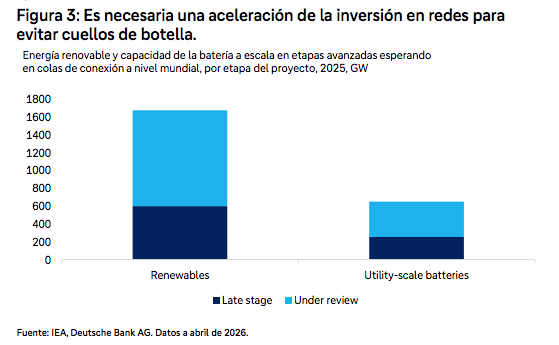
However, the IEA notes that, although spending on renewable generation has almost doubled since 2010, global investment in grids has remained broadly stable at around USD 300,000 mn per year. To meet climate and energy security targets, it estimates that investment in grids must almost double to exceed USD 600,000 mn annually by 2030, with a strong emphasis on the modernisation and digitalisation of distribution networks.
The urgency of this challenge continues to be underestimated, although under-investment has already led to system bottlenecks. Globally, the IEA estimates that at least 3,000 GW of renewable projects – including some 1,500 GW at advanced stages of development – are currently waiting in queues to connect to the grid. This is equivalent to nearly five times the amount of solar and wind capacity added worldwide in 2022.13 Europe provides a clear illustration of the costs involved.
Congestion management costs amounted to approximately EUR 9,000 mn in 2024, whilst 72 TWh of predominantly renewable electricity was curtailed due to bottlenecks – equivalent to around Austria’s annual electricity consumption. Electrification in the US is driven by different factors. Historically, it has progressed unevenly and has often been driven by demand rather than by a national security imperative. This remains the case: BloombergNEF estimates that over 80 per cent of the new electricity capacity added in the US in 2025 – comprising solar, wind and storage – was driven by demand from data centres, particularly those linked to AI. The rapid rise in electricity demand from data centres is placing increasing pressure on local grids and transmission infrastructure, and investment in US grids has begun to respond, rising by 9.5 per cent to USD 115,000 mn in 2025 – though this remains insufficient to meet the system’s needs. By the end of 2024, more than 10,300 projects (representing approximately 1,400 GW of generation capacity and 890 GW of storage capacity) were seeking grid connection in the US.
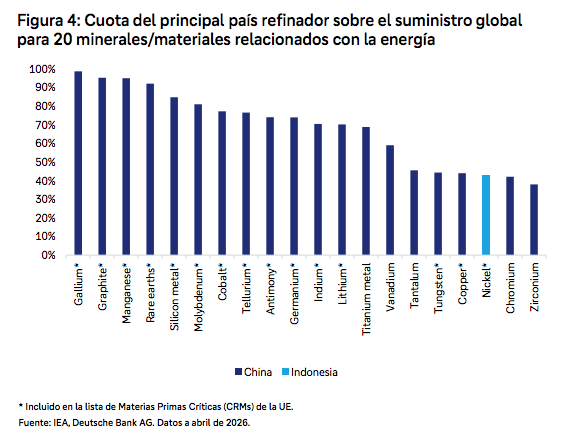
As electrification becomes increasingly infrastructure-led, it also becomes more material-intensive. Clean energy technologies and electricity grids rely on large volumes of critical minerals – including copper, aluminium, lithium, cobalt and nickel – used in wind turbines, solar panels, batteries, power electronics and grids). Between 2023 and 2024, global demand for lithium rose by almost 30 per cent, whilst demand for nickel, cobalt and graphite increased by between 6 per cent and 8 per cent. On current trajectories, demand for critical minerals could double by 2030. Supply chains for critical minerals are also geographically concentrated and, in several cases, dominated by a small number of countries. China accounts for around 92 per cent of global rare-earth refining capacity and around 77 per cent of cobalt refining, highlighting this new strategic exposure.