ECB

eurozone inflation

ECB’s time for truth

MADRID | By Ana Fuentes | It’s been the talk of the town for months, driving up demand for government bonds in the eurozone, pushing yields to record lows and heating the debate among market makers. And yet nobody knows the scope of the European Central Bank’s next move. The much-awaited quantitative easing (QE) program is expected to be officially announced after 14.30CET today and include controversial sovereign bond purchases of €50-70billion euros per month until the end of 2016. Is the ECB late? Will the ECB manage to spur growth in the eurozone with that amount? 


draghi preocupadoTC

Draghi’s deal

MADRID | By J.P. Marín Arrese | Mario Draghi has snatched green light for launching his coveted bond-buying scheme. In exchange, he has caved in to German pressure transferring the potential losses to the national banks. The ECB may seem to have lost its independence but striking such a deal was worth the price. 


money1

QE and OMT are not the same thing

PARIS | By Francesco Saraceno | I think it is important to clarify once more that QE and the OMT (welcome to the wonderful world of EU acronyms) are not the same thing. If Mario Draghi manages to rally the Governing Council behind him, QE will consist of a vast program of sovereign bond purchases, in order to try to lift the European economy out of deflation. A European version in short, of what was done three years ago by the Fed and other major central banks in the world.


No Picture

EU Court’s green light for QE

MADRID | By J.P. Marín Arrese | In the OMT case brought before the EU Court of Justice by the German Constitutional watchdog, the Advocate General has delivered a positive opinion. As the Court usually follows such opinions, the last hurdle for implementing the planned QE has been lifted. Yet, the Advocate General sets a number of requirements that will curtail the ECB’s room of manoeuvre.


No Picture

ECJ: Green light to ECB’s bond purchase

LONDON | Barclays analysts | The European Court of Justice has already published its opinion about the Outright Monetary Transaction (OMT): the ECB’s anti-crisis plan was “necessary” and “in principle” is in line with EU law. This much awaited opinion  will have important implications for any broad-based ECB government bond purchases (QE), which we think are likely to be announced next week.


No Picture

Eurozone: Deflation and weak activity support QE

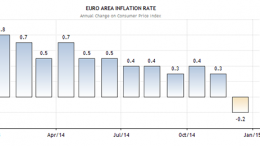
LONDON | Barclays analysts | We believe this week’s data on inflation and economic activity have provided more arguments to step up ECB’s asset purchase programmes by including EGBs on 22 January, which is our baseline scenario. Inflation entered negative territory in December and is likely to stay negative for a few months before a weaker euro improves the inflation and growth outlook.


No Picture

Where now for the euro?

MADRID | By Sean Duffy | The euro hit a fresh nine-year low on Thursday after the publication of a letter from Mario Draghi which indicated that the central bank would likely purchase sovereign bonds in a bid to ward off a deflationary bout which is holding back growth on the continent. The euro was trading at $ 1.17540 against the greenback on Thursday.  Friday saw a recovery to $ 1.18177. The single currency is currently hovering around levels seen back when the currency was launched in 2002, at €1.16.


No Picture

ECB bound to act

MADRID | By JP Marín Arrese | Central bankers would be ill-advised to cave in to pressure from the markets. Yet, the ECB can hardly resist the urgent need to implement a fully-fledged QE programme involving sovereigns. Anything less could end-up sparking a period of vicious turmoil as Syriza seems poised to win the upcoming elections in Greece and the oil market continues to tumble into utter disarray. Such a grim outlook requires drastic action. Would it solve all the current problems? There are plenty of reasons to doubt it.


bini

“The ECB can implement quantitative easing in a much more aggressive way”

MADRID | January 5, 2015 | By Ana Fuentes | Dissensions at the ECB’s the Governing Council are well-known, and still have a long way to go. While some counselors require a truly expansive monetary policy which helps curbing the deflationary expectations, others deny these latter and therefore refuse to go further and define balance sheet expansion targets. Lorenzo Bini Smaghi, who was Member of the Executive Board of the European Central Bank from June 2005 to November 2011, is among those who believe that the ECB can take much stronger action.