eurozone

inflation europe

Europe: Quo vadis inflation?

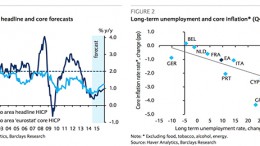
MADRID | The Corner | Although the eurozone final consumer price data for June came in line with their expectations, analysts at Barclays believe the common currency club may struggle to absorb “rising labour supply into employment given growth potential.” That is why further structural reforms to expand labour-absorption capacity are essential to avoid persistent disinflation on wages and, ultimately, consumer prices, they say. 


No Picture

European banks sold off sharply in the past month

MADRID | By The Corner | Experts at JPMorgan think that it is largely due to positioning, regulatory concerns and profit-taking post ECB announcements in June. However, their funding costs have barely moved in the meantime and remain near historical lows. This is likely to have helped their earnings further in Q2.


No Picture

Industrial Production: Will there actually be an acceleration in 2S14?

MADRID | The Corner | After France and Italy’s (second and third most important countries in the single currency bloc) poor industrial production data of -1.9% (vs previous -0.51%) and +1.4% (vs previous +0.2) respectively, expert at Barclays Alberto Vigil wonders why analysts are so sure that there will be an acceleration in the 2S14.

*The green line is the Eurozone’s GDP, whereas the other two are Italy’s and France’s industrial production.


No Picture

Euro crisis turning point: Two years of banking union

Europe’s leaders avoided their usual muddling through complacency to do something radical — and it worked. Europe’s banking union, constituting a supranational pooling of most instruments of banking policy, was established over two years ago, in the early hours of June 29, 2012. To a greater extent than was initially realized by most observers, this step marked a watershed in the European crisis by making it possible for the European Central Bank (ECB) to stabilize sovereign debt markets.


No Picture

European banks raised €35 billion in CoCos in 2014

MADRID | By The Corner | European banks have strenghtened their capital ratios for the upcoming stress tests and the AQR, whose results will be known after the summer. In that sense, between July 2013 and May 2014, EZ lenders increased their base capital by €45 billion, although it wasn’t entirely by issuing shares but contingent convertible bonds (CoCos), by which they would have raised around €35 billion.


No Picture

“We’ll see zero credit growth in the Monetary Union in the next 2 years”

WASHINGTON | By Pablo Pardo | Mark Zandi is chief economist at Moody’s Analytics, the department in charge of consulting, advising and providing services for businesses and financial institutions. Among its many activities, the firm advices several European banks with regard to the EBA’s and ECB’s stress tests. Moody’s created this department in 2007, after buying Economy.com –Zandi’s analysis company.


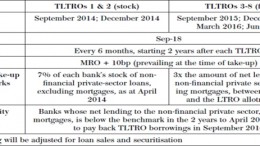
tLTROs main features1

ECB’s Praet: TLTRO will break the lack of credit’s vicious circle

MADRID | The Corner | Upcoming TLTRO in Sept 18 and Dec 11 will allow EZ banks to borrow an amount equivalent to 7% of what they currently lend to the private sector at 0.25% a year (excluding interbank loans and mortgages), breaking the vicious circle of high lending rates to companies, high credit risk and a sluggish economic performance, European Central Bank’s chief economist Peter Praet said on Wednesday. 


No Picture

Why waste time with Taylor-Rules?

SAO PAULO | By Marcus Nunes via Historinhas | That´s what Simon Wren-Lewis does in “Taylor Rules, the ZLB and Euro Diversity”: John Taylor originally suggested his rule as both a good guide to what central banks actually do and also one that “captures the spirit of the recent research”. It has been used ever since as a yardstick by which to measure monetary policy.


lander

German budget consolidation under threat by its own Länder

BERLIN | Alberto Lozano | While German Finance Minister Wolfgang Schäuble preaches public budget consolidation all around the Eurozone, some Länder don’t seem to be taking his prescriptions seriously. Their deficits continue to grow in 2014 and moving away from the zero deficit goal in 2020 as required by the country’s constitution. 


No Picture

EZ lending activity improvement compromised

MADRID | The Corner | While the European inflation remained at 0.5%, credit steeply contracted in May thus neutralising the tepid improvement of the lending activity during March and April, according to Afi. The decline in private credit accelerated in small peripheral countries, but it continued the same in Spain and Italy.