eurozone

michelangelo creazione di adamo 640x260

Italy Accuses Rating Agencies of Ignoring Its Patrimony- Should Spain, Greece Join In?

OP-ED By Ana Fuentes | Italy’s Corte dei Conti has opened an investigation against rating agencies for unjustified downgrading of the country in 2011 and 2012. S&P, Fitch and Moody’s face a potentially huge claim of €234bn for not considering Italy’s contribution to the world’s cultural patrimony. Will other countries follow Rome? Should the Parthenon or the Alhambra be taken into account when deciding Greece or Spain sovereign debt value?


eurito

Credit deterioration in the euro zone hits rock bottom

MADRID | By Carlos Díaz Güell | Trend of credit fall in euro zone core countries as well as in peripheral ones has shifted direction thorought 2013: it moderated in Europe’s periphery while slowing down in central economies.The rate between credit and deposits has moved under 100% for the first time, which illustrates the euro zone strong deleveraging process.


Euro fears deflation

Losing patience with the ECB

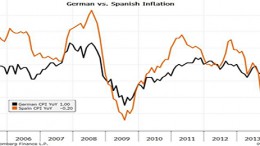
MADRID | The Corner Team | Investors are most likely to hear the ECB repeat (again) how prepared it is to act and use all kind of unconventional devices on next Thursday meeting, after inflation in the euro zone fell to 0.7% in December, its lowest level since the common currency was born. “As fears of  deflation increases, the central bank cannot remain unable to act,” analysts say.


Lagarde and Draghi

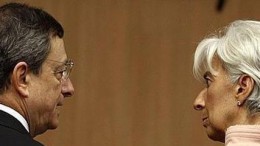
Lagarde and Draghi: train crash at Davos

MADRID | By Julia Pastor | Christine Lagarde, Managing Director of the International Monetary Fund  and Mario Draghi ECB’s president were in the same Davos panel on Saturday. Both talked about signs of recovery across the world and the euro zone. However, as she said that deflation potential risks in the euro zone must not be ignored, he minimized danger and insisted once more that the bank is prepared to deploy a QE’s policy if deflation appeared.


No Picture

Draghi Calls For Caution Amid Markets’ Excessive Euphoria

MADRID | By Francisco López | In the midst of the markets’ euphoria thanks to the sharp fall in the risk premiums of peripheral countries, the big commander came and ordered to stop. The president of the ECB, Mario Draghi, appealed to investors to be cautious facing the risks of a “fragile and weak” recovery in the Eurozone and about an inflation whose expectations on the medium-term have worsened.


ECB Attentive to money market conditions and inflation outlook

ECB: Attentive to money market conditions and inflation outlook

LONDON | By Barclays analysts | The ECB left monetary policy unchanged as expected and strengthened the downside bias of its forward guidance somewhat. Mario Draghi insisted on the fragility of the economic recovery and repeated that the ECB would be ready to act should downside risks materialize. We still think that monetary policy should be kept unchanged at least for the next two years, but we acknowledge the risk of further easing should inflation and inflation projections fall further. Besides, liquidity measures could be introduced to support the financing of the economy.


No Picture

France: Where reforms need to be made

LONDON | By Barclays analysts | France’s macroeconomic situation does not look that bad and on average the country compares well with other developed economies. It does not suffer from a major imbalance in terms of yearly flows (trade, finances, etc). However, weaknesses, perniciously accumulating over the years, have now been laid bare by the crisis.


Eurozone

After Austerity, Capital Inflows Will Ease Euro Zone’s Pain

THE CORNER TEAM | Although fiscal austerity and structural reforms implemented have inflected some euro zone countries a severe pain, they will bring them external capital inflows, Chinese rating agency Dagong Credit predicts for 2014. This combined with the potential increase in Germany’s import demand will mean that the euro zone economies will rebound a little and see pressure of sovereign debt crisis ease further.


ECB Doctrine (e.d. Bundesbank’s)

ECB Doctrine (e.d. Bundesbank’s)

MADRID | By Luis Arroyo | ECB’s policies have damaged more than helped the European economy. After all, the FED has managed to steer the US towards the path of growth, while the ECB is unable to make its policies work. But the truth is, they are not entirely the ECB’s but the Bundesbank’s procedures commanded by Ms Angela Merkel.