
Germany

No Picture

Time for ‘Draghilogists’

FRANKFURT | By Lidia Conde | Experts don’t agree about what can happen in the short and medium term in the Eurozone. The main critical voice is the president of Munich’s Ifo Institut, Hans-Werner Sinn, who believes that Europe is in a “resting phase” before the storm hits again. According to Germany, now is the time of the “Draghilogists”, i.e. those analysts who try to elucidate the ECB’s next step.

energy prices

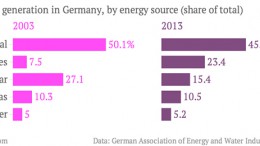
Industry wins in Germany’s energy transition

BERLIN | By Alberto Lozano | The German ambitious switch from nuclear and carbon-based energy toward renewables remains the biggest challenge for the first EU economy. The country’s industrial sector and consumers are worried about how much they will have to pay in terms of prices, competitiveness and jobs.


boy combing hair

Stress tests: EU banks start tarting up

MADRID | By Julia Pastor | As the ECB’s crucial examination comes closer, all European entities, from the core to the periphery, have started studying different formulas to show the best capital ratios possible. German banks would imminently issue CoCos, while Italy’s could be about to create a joint bad bank and Spain is to monetize around €40 bn of deferred tax assets. The stress tests’ results will be released at the end of October 2014.


Euelections

EURO ELECTIONS: Germany will win, no matter what -but does it care?

BERLIN | By Alberto Lozano | The upcoming EU elections (May 22-25) arrive in a moment of enormous challenges for the Union. What happens in the next months can change definitely the political and economic landscape. Again, Germany plays the main role with its 67 million of voters and the two ‘frontrunners’ supported by the two big parties from the German Coalition. However, 72% of its citizens have low or no interest in the polls.


deflation

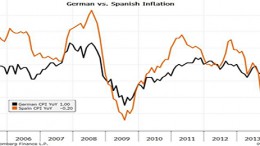
ECB: Wait, wasn’t inflation target 2pc?

MADRID | By The Corner | “I would like to stress that the risk of a self-reinforcing deflationary downward spiral consisting of falling wages and prices, as evoked by some, is also low, despite the present, very low inflation rates in the euro area. These are mainly a result of falling energy prices and the adjustment process in crisis countries,” European Central Bank Governing Council member Jens Weidmann said on Tuesday, playing down deflation risk. Anyway, what happened with the ECB’s 2pc inflation target?


Angela' s lies

Angela’s little lies

BARCELONA | By Vinçent Navarro | Germany is not only about minijobs. Although Southern European economies are debating about this measure that Berlin took under Schröder’s government in order to tackle unemployment, much less is said about the German model or ‘Rhineland capitalism’, essentially based on works councils and co-management.


No Picture

Today’s market chatter in Spain

MADRID | By Jaime Santisteban | Market makers woke up with a torrent of data explaining how first quarter played out: Spanish public deficit, Eurozone’s activity indicators, and many more.


minijobs

SPECIAL REPORT: Are minijobs a solution for Europe?

BERLIN | By Alberto Lozano | Europeans never stop listening to ideas for economic reforms. One potentially successful option, with support from Europe’s leading institutions for smaller economies, is the ¨minijob¨.

But are these atypical jobs the solution to move Spain’s 26 percent unemployment rate closer to Germany’s 5 percent?


No Picture

Germany feels sure about European rescue fund- not ECB’s OMT

MADRID | By Julia Pastor| German judges are removing uncertainties little by little. The country’s Constitutional Court confirmed on Tuesday that the European Mechanism of Stability is legal and does not damage the Bundestag’s budget. Furthermore, they also approved euro zone’s fiscal pact. The court had brought an appeal against constitutionality of both treaties in June of 2012. The third appeal regarding ECB’s bond purchase program is still pending of a sentence, however, and apparently it would be more difficult to solve: Karlsruhe’s court has required European Court of Justice to decide against the program following the arguments -more economic than legal- that Bundesbank has handed to them.