

Spain

No Picture

“Spain will repeat its success as tourist destination in 2014”

FRANKFURT | By Lidia Conde | Co-manager at Europe’s leading travel group TUI Oliver Dörschuck considers that “Spain is by far the most important tourist destination for TUI and its clients.” However, for him what matters most today is not the destination, but the hotel, which has to bring the best experience to the client.


king juan carlos

Are Spanish media betting on King Juan Carlos again?

OP-ED By Julia Pastor | Spaniards disaffection with monarchy sank to lowest levels in 2013 after several embarrassments and corruption scandals affecting the Royal Family. But as King Juan Carlos wraps up his 6th visit to UAE on Wednesday, Spanish media of all political signs are sticking to his diplomatic role. The monarch is seeking to open doors for Spanish infrastructure companies. Only Abu Dhabi’s subway is to raise €8 bn.


Spaniards

Spaniards did rescue Spain

OP ED by Julia Pastor | Brussels welcomed Spain’s economy timid comeback to the path of growth in 4Q13. When some financial publications wonder who saved the country, they quote Draghi’s OMT as well as the internal devaluation followed to PM Mariano Rajoy’s reforms. They do not mention, however, that due to internal devaluation Spaniards have seen their salaries cut by an average of 10%, and 27% of household depends on retired people pensions, who are even assuming mortgage loans their kids can’t pay anymore.


deflation

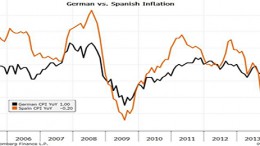
ECB: Wait, wasn’t inflation target 2pc?

MADRID | By The Corner | “I would like to stress that the risk of a self-reinforcing deflationary downward spiral consisting of falling wages and prices, as evoked by some, is also low, despite the present, very low inflation rates in the euro area. These are mainly a result of falling energy prices and the adjustment process in crisis countries,” European Central Bank Governing Council member Jens Weidmann said on Tuesday, playing down deflation risk. Anyway, what happened with the ECB’s 2pc inflation target?


No Picture

Today’s market chatter in Spain

MADRID | By Jaime Santisteban | Market makers woke up with a torrent of data explaining how first quarter played out: Spanish public deficit, Eurozone’s activity indicators, and many more.


Champagne Bottle

Market chatter: bonds await ECB’s move

MADRID | By Julia Pastor | European sovereign bonds markets have put some champagne bottles on the fridge for next neek in the case the ECB decides to inject some stimulus on the euro zone at last. Without setting a precedent, president Mario Draghi and Bundesbank’s head Jens Weidmann seem to bring their positions over the mechanism closer. This change of direction led Spanish 10-years bonds to 2005’s minimum yields of 3.27% and was behind the successful issue of Italian public Treasury, which sold €2.5 bn at also very low prices. Just Greece’s bonds are trending downwards.


No Picture

Shiller backs Abe and Roosevelt… what’s Merkel say on that?

MADRID | By Luis Arroyo | Nobel laureate economist Robert Shiller discusses the issue of the so-called “animal spirits” and what should be done in order to pump trust. He uses a visit to Japan as a base to show how effective the politics by Mr. Abe were. Japan is the country that has reduced the gap with the potential GDP.


ecb stress tests

Why is the ECB so demanding with Spanish banks?

MADRID| By Francisco López | Spanish banks are the most closely examined in the world, but it does not seem to be enough for supervising institutions. The ECB has urged them to undergo a new and comprehensive assessment of their exposure to real state sector before the European banking industry’s Asset Quality Review previous to the stress tests that will take place by the end of the year. The central bank has rejected that Spain’s entities use 2012’s review by audit firm Oliver Wyman. Even though ,they reckon, that would save money and time.


No Picture

Spanish Public Debt Reaches One Trillion

MADRID | By Fernando G. Urbaneja | Spanish households and businesses were the most indebted at the beginning of the crisis (80% of the total), but now their debt is getting smaller in a systematic and decided way. The same cannot be said of the State, which keeps increasing its public debt with equal zeal (or even more) and has gone from less than 20% at the beginning of the crisis to 36% this week (and still growing).