
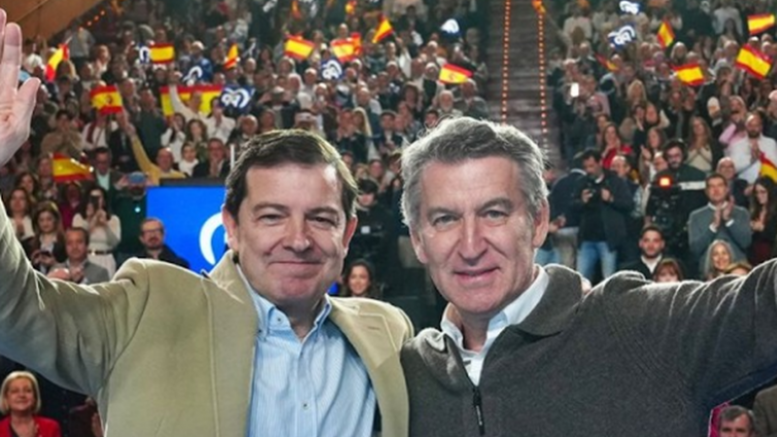
The PP (People’s Party), with 35% of the vote and 33 seats—two more than it previously held—has won the elections held yesterday in Castilla y León, where two-thirds (65.7%) of the just over two million people called to the polls turned out to vote. Consequently, the acting president and PP candidate—representing a party that has governed the region for 39 years—Alfonso Fernández Mañueco, is the only one with real possibilities of forming a government. To do so, he will need the explicit or implicit support of Vox, the party to his right, which has consolidated its position as the third force in this community, obtaining 14 seats, one more than it previously had. Vox secured 18.9% of the vote, though its leaders, guided by polls, expected more and were confident of reaching 20% of the ballots.
The PSOE (Socialist Party), led in the region by the mayor of Soria, Carlos Martínez, has captured the entire left-wing vote—obtaining 31%—and has managed to halt the party’s freefall by securing 30 seats, two more than it previously held. The “Sanchista” party seems to have capitalized on its “no to war” stance and its confrontation with Trump at the cost of absorbing all left-wing votes (32,7%) —Sumar, IU, Podemos… failed to win a single seat—meaning that in Castilla y León, there are no longer any parties with representation to the left of the PSOE.
Unión del Pueblo Leonés (UPL) managed to maintain its 3 seats, while Soria Ya lost two of its three seats to the PSOE, keeping only one, the same as “Por Ávila.”
Since a majority in the regional parliament requires 42 seats, only the combination of PP and Vox, who took 54% of the vote and together hold 47 seats, has real possibilities of forming a government.
The same situation applies in two other autonomous communities—Extremadura and Aragon—where the PP also won but requires at least an abstention from Vox to govern. Vox had chosen to wait for these elections in Castilla y León to determine its exact negotiating position.


