
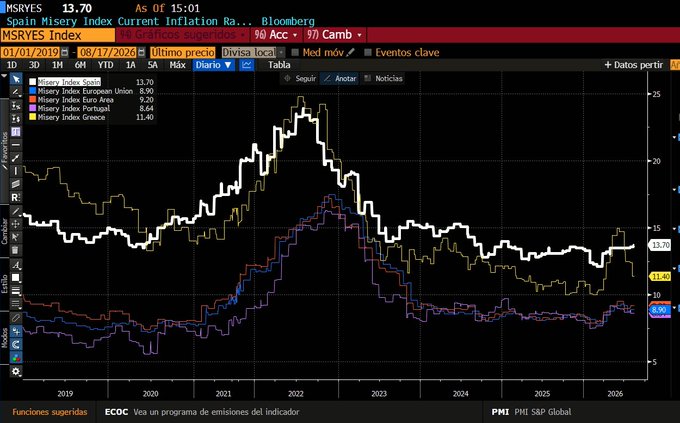
Spain’s “Misery Index,” as measured by Bloomberg (13.7), is worse than that of Greece (11.4), Portugal (8.64), the European Union (8.9), and the Eurozone (9.2). The Misery Index is a simple economic indicator designed to measure the economic discomfort or stress felt by the average citizen in a country. It was created in the 1970s by American economist Arthur Okun and is calculated by adding two key variables:
Misery Index = Unemployment Rate (%) + Inflation Rate (%)
The higher the score, the greater the economic “misery”: If a country has 10% unemployment and 4% inflation, its misery index is 14.
Combined effect: It reflects the worst-case scenario for a consumer: not having a job (or fearing losing it) while the cost of living continuously rises at the same time.
Over the years, economists like Robert Barro and Steve Hanke created expanded versions. For example, Hanke’s Misery Index adds unemployment, inflation, and bank lending rates, but subtracts the percentage change in real GDP per capita to provide a more comprehensive picture of the overall state of the economy.
Spain, with unemployment at 9.87% and an HICP (Harmonised Index of Consumer Prices) reaching 3.9%—the standardized indicator used by Eurostat to make homogeneous comparisons across European Union countries—yields a “Misery Index” of 13.7.


