

Articles by The Corner

About the Author

The Corner
The Corner has a team of on-the-ground reporters in capital cities ranging from New York to Beijing. Their stories are edited by the teams at the Spanish magazine Consejeros (for members of companies’ boards of directors) and at the stock market news site Consenso Del Mercado (market consensus). They have worked in economics and communication for over 25 years.
No Picture

German Ifo business climate falls to 6-month low

MADRID | The Corner | The  much-awaited German Ifo Business Climate Index for industry and trade fell to a seasonally adjusted 109.7 points this month, below forecasts for 110.2 and down from 110.4 in May. Although the country’s firms still make positive assessments of the current business situation, the Munich-based institution explained in a press release on Tuesday, they feel less optimistic about the future. And fear the potential impact of the crises in the Ukraine and Iraq.

No Picture

The euro goes negative

NEW YORK | By Dickson Buchanan Jr. via Truman Factor | The European Central Bank’s (ECB) decision to charge a negative interest on overnight deposits is not going to lead to a higher targeted inflation rate, despite ECB President Mario Draghi’s insistence that it will. Like all cases of central planning, this decision will have unintended and costly consequences – some of which are already starting to play out. 


No Picture

Asked for wider liberalization, many Germans don’t see more room for it

BERLIN | By Alberto Lozano | Although when speaking of reforms nobody is pointing to Germany, international organizations are pushing for it in the country, especially in the services sector. The goals are boosting consumption and rebalancing the euro monetary union, and higher productivity in services sector becomes a challenge with large potential gains for both Germany and the whole Eurozone. But some voices insist this won’t easily happen. 


raising capital

One in three EZ banks needs to raise capital

MADRID | The Corner | The European banking industry has already increased capital for €25.7 bn this year. According to an Ernst&Young’s poll they could continue doing it after next October’s stress tests. Of those 294 European financial entities surveyed, 30% say they can not rule out a capital increase at all- mainly Spanish and Austrian-, while 8% affirm they will probably need to do it.


No Picture

Subsidiaries say goodbye to EU’s tax loophole

MADRID | By The Corner | It was a tax loophole worth billions of euros. And finally the EU-28 finance ministers came to a political agreement on Friday to tighten it up. From now on, European tax rules will be tougher on those multinationals trying to avoid taxation. The compromise was possible after Malta dropped its objections to a deal on hybrid loan arrangements. “That is good news for public budgets, good news for honest businesses and good news for those who seek fair taxation in the EU,”  Commissioner Algirdas Šemeta said.


No Picture

Stage two of the Japan macro trade

LONDON | By Barclays analysts | The Japan macro trade has been off the radar in 2014, but that should change (for better or worse) in the coming few months. US yields have likely bottomed, while the effect of Japan’s VAT increase appearsmanageable. More important, PM Abe has unveiled more details of his 3rd Arrow (the structuralreform program), including a long-anticipated cut in the corporate tax rate.


spain-italy

The fair value for Italian and Spanish spreads

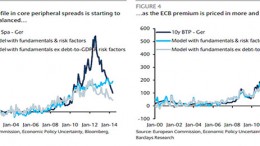
LONDON | Cagdas Aksy at Barclays | A model framework, which takes into account economic/fiscal fundamentals and risk aversion factors, indicates a fair value level of about 200bp for 10y Italy and Spain vs Germany. The high debt problem for most peripheral countries is something that will take many years to reverse and the ECB’s commitment through OMT and potential QE can contain these concerns to a large extent, as long as it maintains its credibility. Under this more optimistic scenario, fair value moves down to 90-100bp. After 350-400bp of tightening over the past two years, 10y core periphery spreads are 30-40bp away from stretched levels.


Argentina's default 2

Argentina and the economic crisis cliff

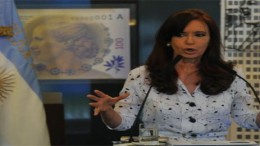
Amid an important devaluation of its currency, and with its central bank rapidly losing reserves, Argentina is entering a critical stage as it attempts to avoid a new economic crisis. In November 2013, Argentine President Cristina Fernandez de Kirchner decided to limit her public appearances and delegate to new ministers. Economy Minister Axel Kicilloff and Chief Minister Jorge Capitanich were tasked with revising the economic course of a government that is starting to show weaknesses. Today, not only is the Argentine public worried, but so too is the international community.