
In Europe

greece1

Greece: Drop ‘til you shop

ATHENS | By Nick Malkoutzis | It seems slightly surreal to be discussing whether shops in Greece should open on Sunday when household disposable income has dropped by around 30 percent since 2010 and we have seen the emergence of consumers of need rather than choice. Nevertheless, this is the debate that has been prompted by a new law allowing stores in 10 areas of Greece to open every Sunday.


Credit flowing

Credit in Europe – is it finally set to turn?

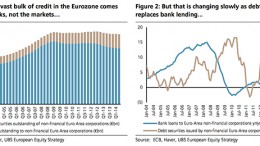
LONDON | The Corner | The winners in the “race for recovery” are those who get credit flowing again. In their Wednesday comment, UBS Global Macro Team points out that “the key to recovery coming out of a credit crunch is to get credit flowing again: the US and, to a lesser degree, the UK managed this in the early years following the financial crisis, but the Eurozone is still grappling with the issue. We think this one factor is the best explanation for the outperformance of US equities over Europe post-crisis. The S&P 500 is up 190% from the March 2009 lows, whilst Europe is up 120%.”


jyrki katainen

Olé, Katainen

MADRID | The Corner | New Commissioner for Economic and Monetary Affairs Jyrki Katainen –Finnish, as his predecessor Olli Rehn- has pledged pure orthodoxy about the European Stability Pact. In an interview with German daily Die Welt, Finland’s former Prime Minister and now one of the most powerful men in the EU ruled out speculations about creative interpretations of the fiscal framework. Mr Katainen is the same who, during the worst moment of the crisis (Aug 2012), asked Greece and Spain for collateral in exchange for aid and reckoned that some peripherals were introducing major structural reforms that were “simply not being recognized in the market.”


No Picture

In third straight month of decline, industrial turnover falls 4.9 pct in May

ATHENS | Via Macropolis | The Turnover Index in Industry continued heading south for the third successive month dropping by 4.9 percent in May from a revised -10.5 percent in April, according to the Hellenic Statistical Authority (ELSTAT). The May performance indicates the ninth negative reading in the past 17 months, while four months showed a double-digit drop over this period.


inflation europe

Europe: Quo vadis inflation?

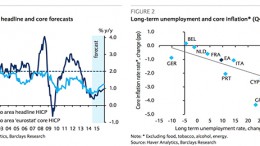
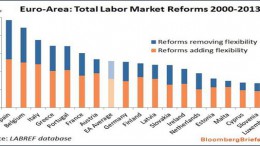
MADRID | The Corner | Although the eurozone final consumer price data for June came in line with their expectations, analysts at Barclays believe the common currency club may struggle to absorb “rising labour supply into employment given growth potential.” That is why further structural reforms to expand labour-absorption capacity are essential to avoid persistent disinflation on wages and, ultimately, consumer prices, they say. 


catalonia

Catalonia exit: a financially doomed move

MADRID | By J. P. Marín Arrese | Water and power supply would be secured should Catalonia become an independent nation. That’s the only reassuring conclusion the economic think tank set up by the regional government has recently reached. On handling monetary and financial issues, it points to severe problems ahead. 


No Picture

Germany: Austerity actually works

FRANKFURT | By Lidia Conde | Is austerity at all costs killing us? Germany answers with a resounding “no.” Even though the North-South axis in the European policy is more present than ever, for Berlin “austerity does not punish.” On the contrary: it even purifies. Furthermore, the Stability Pact offers enough flexibility so as to boost growth. There is no room for revision or debate.


juncker1

Juncker: will we see some Junck Bonds?

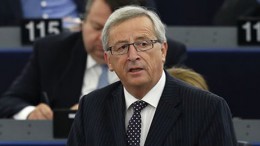
MADRID | The Corner | President elected of the European Commission Jean-Claude Juncker will officially start his mandate on November 1. He describes himself as a “champion of the social market economy” –although he says it would only work with social dialogue, insists that he is not a federalist and calls for a “re-industrialisation of Europe.” What else should we know about him.


No Picture

Implications from the reduction in Equity Weights

ZURICH | The Corner | UBS team reduced on Thursday their Overweight in Global Equities. In the near- term, they see some deterioration in the risk/return trade off, following a large re-rating in equity markets. However, the context is that they are coming from their largest ever Overweight in Equities and that it still remains their favoured asset class (with European Equities as an Overweight).