
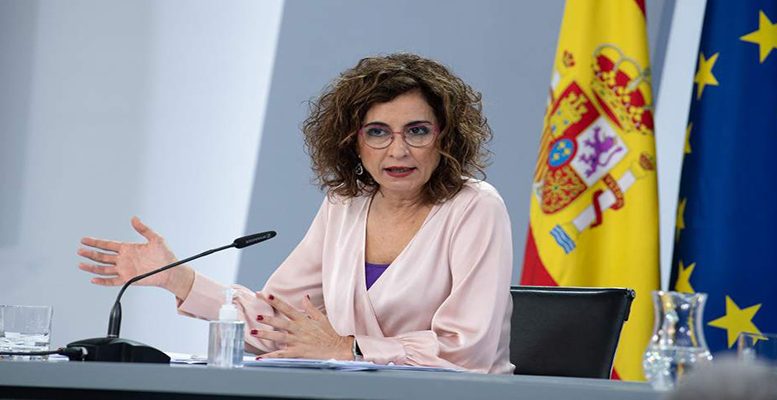
The newspaper El Mundo explains that “the PSOE is silencing the head of the Fiscal Authority and preventing her from criticizing in Parliament the lack of Budgets amidst the Iran crisis and the pact with Junqueras.”
This is because, according to what Cristina Herrero—who until the 4th of this month presided over the Independent Authority for Fiscal Responsibility (AIReF)—explained to them, she requested weeks ago to meet with the First Vice President of the Government, María Jesús Montero, at the Ministry of Finance to present her latest concerns regarding the sustainability of the State’s accounts. She also asked the Socialist chairman of the Congressional Finance Committee and Montero’s trusted associate, Alejandro Soler, for the opportunity to appear in Parliament one last time after six years in office. The answer to everything was no. Montero has refused to receive her, and Soler has not only failed to convene the parliamentary committee to hear Herrero but did not even inform the other political forces of the AIReF president’s wish to address them for the last time.
The reality is that only inflation, which is crushing the purchasing power of Spaniards, has caused the debt-to-GDP ratio to drop to 100.8% of GDP in 2025. This represents a 23.4 percentage point decrease from 2021, when it reached its historic peak. In nominal terms, the volume of public debt reached €1.7 trillion in 2025—though this figure refers only to debt computable for the purposes of the EU’s excessive deficit procedure—after growing by 4.8% year-on-year.
The Independent Authority for Fiscal Responsibility (AIReF) published a new edition of its ‘Debt Observatory’ this Thursday, examining the recent evolution of Spanish public debt. It warned that, although the recent trajectory has been favorable, maintaining long-term sustainability will require additional fiscal efforts in a context marked by demographic shifts, new spending needs, and a more uncertain macro-financial environment.
In the medium term, the report identifies elevated risks. Under a “no-policy-change” scenario, public debt would decrease slightly until 2028 but would subsequently rise again to sit around 108% of GDP by 2036, driven by persistent deficits and increased spending associated with an aging population.
Specifically, the analysis estimates that it would be necessary to improve the structural primary balance by 5.3 percentage points of GDP to stabilize debt in the long run, primarily due to the rise in spending on pensions, healthcare, and long-term care. Furthermore, an adjustment of 4.8 points of GDP would be required to reduce debt to 60% of GDP—by the year 2070!
AIReF is one of the few independent voices still heard within the Spanish public sector. Therefore, true to form, the Government is prepared to silence it by appointing a sub-director from the Ministry of Finance, Inés Olóndriz, to replace Cristina Herrero, who has just concluded her mandate.
Appointing a subordinate to head an independent authority is so embarrassing that even the pro-government newspaper El País saw fit to raise its voice slightly with an editorial titled ‘Inappropriate Appointment’ and a brief summary explaining that: ‘The proposal of a high-ranking Finance official to lead AIReF is a slight to the necessary appearance of impartiality of independent institutions.’ The necessary appearance? Why?


