
In Europe

No Picture

Greece ponders how to deal with rising unpaid private debt, which hit 88 pct of GDP

ATHENS | Via Macropolis | Unpaid private debt in Greece is estimated to have reached around 160 billion euros, which corresponds to 88 percent of GDP, but was largely ignored until the last few days, when it became a key issue in the discussion between the government and the troika. Apart from the outstanding amount, the dynamic, which clearly shows a steady upward trend, is also a worrying factor.


No Picture

E.ON sells its Spanish business at Ebitda 10x

MADRID | The Corner | Citi will be the senior advisor in the business, whose preliminary assessment goes up to €3 billion. The major stakeholders would be Energía Villar Mir, EDP and several funds (such as KKR, Riverstone, Brookfield, Blackstone and JPMorgan’s infrastructure fund).


juncker

Juncker: 300bn to boost Europe’s growth

MADRID | The Corner | He praised budget contention and austerity, and yet his first announcement as the European Commission new president has to do with investment: Jean Claude Juncker called for a 300 bn euro public-private  investment reindustrialisation programme over the next three years.


shoppers retail sales gro 014

UK inflation sharp jump fuels expectations of rates hike

MADRID | The Corner | UK Consumer Prices Index (CPI) grew by 1.9% in the year to June 2014, up from 1.5% in May, according to official data released on Tuesday, almost reaching the Bank of England’s 2% target and strenghtening the case for a rise in interest rates which have been held at a record low of 0.5%.


No Picture

What if we are in a 2% growth world?

MADRID | By The Corner | Experts at JPMorgan are less worried about near-term disturbances and flows and more about the medium-term outlook for economic growth. Over the past three years, the world economy has grown only at a 2.5% pace, below potential and thus not able to make up for what we lost in the recession. Each year, they keep forecasting that growth will rise to a 3% handle, but have been steadily disappointed.


No Picture

Morgan Stanley: “Portugal is now a good buying opportunity”

MADRID | By The Corner | Experts at Morgan Stanley consider that Portugal is now a good opportunity due to its current technical levels. Since the Espirito Santo incident, the PSI20 has plummeted by 17.5%, but these analysts see a potential technical recovery of 10-12%. The Portuguese treasury has covered its entire financing needs for 2014 and is now raising funds for 2015.


BES

Sovereign implications of the Espirito Santo saga

LONDON| By Barclays’ analysts | From the point of view of the banking system as a whole, the sovereign financial implications of Espirito Santo’s affair are rather limited. 
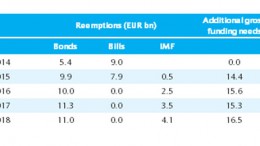
The sovereign has a relatively comfortable cash position and sufficient bank recapitalization funds. Specifically, the government estimates gross funding needs for 2014 of EUR13bn. At the same time, economic activity in Portugal is to expand by nearly 1% this year.


greece

Greece: Public deficit and democratic duty

ATHENS | By Nick Malkoutzis via MacroPolis | A newspaper article on Sunday, quoting an allegedly secret report by officials at Greece’s General Accounting Office and the Hellenic Statistical Authority (ELSTAT), claims that the country’s deficit figure in 2009 was “over-dramatised” (or “sexed up” if you prefer) by the PASOK government that took over in October of that year. 


No Picture

Industrial Production: Will there actually be an acceleration in 2S14?

MADRID | The Corner | After France and Italy’s (second and third most important countries in the single currency bloc) poor industrial production data of -1.9% (vs previous -0.51%) and +1.4% (vs previous +0.2) respectively, expert at Barclays Alberto Vigil wonders why analysts are so sure that there will be an acceleration in the 2S14.

*The green line is the Eurozone’s GDP, whereas the other two are Italy’s and France’s industrial production.


No Picture

Euro crisis turning point: Two years of banking union

Europe’s leaders avoided their usual muddling through complacency to do something radical — and it worked. Europe’s banking union, constituting a supranational pooling of most instruments of banking policy, was established over two years ago, in the early hours of June 29, 2012. To a greater extent than was initially realized by most observers, this step marked a watershed in the European crisis by making it possible for the European Central Bank (ECB) to stabilize sovereign debt markets.