In Europe

spain corruption

Why is Spain Under Suspicion- A Foreign Correspondent’s View

MADRID | By Stefanie Claudia Müller | Foreign media is astonished by how rarely Spaniards seem to protest against corruption within their own state. Although the correspondents try to sell these stories, at home no one seems to be much interested in publishing them, because the fact of a corrupt Spain is according to many European newspapers “old news.” This highlights the fact that Spain’s image problems are not recent.


Mortal disagreement in and for the euro

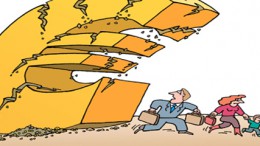
Mortal Disagreement In and For the Euro

MADRID | By Miguel Navascués | There is a harsh disagreement in the euro zone: when Mario Draghi tries to do something, he finds the opposition of Germany and its allies. It seems obvious that Europe won’t get out of the hole with such travel companions.


European Cultural identity

European cultural identity? A matter of dialogue

ROME | By Umberto Eco at L’Expresso via Presseurop | In the midst of the World War One, Marcel Proust created characters who, in spite of the conflict, were attracted by German culture. Proof, according to semiotician Umberto Eco, that cultural exchange has contributed more than anything else to the building of today’s Europe. 


Tenerelli fund manager investing in Spain

Tenerelli, the fund manager who ‘discovered’ Spain in the midst of the crisis

WASHINGTON | By Pablo Pardo | Dean Tenerelli started investing in Spain one year ago. At the time, many of his colleagues thought that he was going too far. Certainly, he went further than anyone else. But, so far, his bet is rendering excellent yields. Tenerelli manages the T. Rowe Price European Stock, a SICAV with more than $900 million (approximately 700 million euros) in assets, of which around $150 million are in Spanish companies shares. Now, others, such as Bill Gates, Warren Buffett and Carlos Slim, have followed this manager’s example and have started to pour money into Spain. Tenerelli has talked with The Corner over the phone about his experience.


No Picture

What are the ECB and Draghi Scared Of?

MADRID | By Fernando G. Urbaneja | In a surprising move, the European Central Bank cut interest rates on Thursday. This is just a sign of the multiple fears shared by the institution and Mr Draghi: the ghost of deflation, the need for credit or the European prices and asset inflation. But both Mr Draghi and the ECB’s credibility have been boosted lately. What are they scared of then?

[Video by FT: “Is Europe getting deflated?”]


No Picture

Germany and its Excusiato Non Petita

MADRID | By Luis Arroyo | Germany prevents the monetary expansion in the country (and within the rest of the euro zone) by controlling the ECB. If the central bank had the minimal amount of money necessary for the area, all of it would go to Germans, who would spend more, thus accelerating the recovery of their European partners.


Little England or Great Britain?

Great Britain vs Little England

LONDON | By The Economist Staff via Presseurop | According to the British newspaper, Great Britain “faces a choice between comfortable isolation and bracing openness. Go for openness. Asked to name the European country with the most turbulent future, many would pick Greece or Italy, both struggling with economic collapse. A few might finger France, which has yet to come to terms with the failure of its statist model. Hardly anybody would plump for Britain, which has muddled through the crisis moderately well.”


ECB inflation

ECB reacts to low inflation and cuts interest rate

LONDON | By Barclays analysts | In a surprise move, the ECB cut the refi rate by 25bp to 0.25% and left the deposit rate unchanged at zero. It also extended its fixed-rate, full-allotment facility to all refinancing operations by one year, at least until mid 2015. The ECB clearly signalled that it is concerned about persistently low inflation, even if deflation risks are contained. We will only know more about how long the ECB thinks low inflation will last next month when it publishes its macroeconomic forecasts. We see euro area inflation in 2014 dropping to 1.0% from the forecast 1.4% this year.


energy policy in Europe

Energy Policy in Europe is Every Man for Himself

FRANKFURT | By at Frankfurter Allgemeine Zeitung via Presseurop | Germany is going down the green energy road, Poland is drilling for shale gas, and the United Kingdom has announced the building of new nuclear plants: when it comes to energy supply and security, the Europeans are hauling in different directions. It’s in their own interest, though, to adopt a common strategy.


No Picture

ECB likely to respond to monetary tightening

LONDON | By Barclays analysts | Disinflationary pressures and significant monetary tightening in the euro area suggest ECB action sooner rather than later. In our view, the probability of an easing at the ECB’s December meeting has increased and will likely be priced-in through a lower EUR heading into the meeting and beyond.