

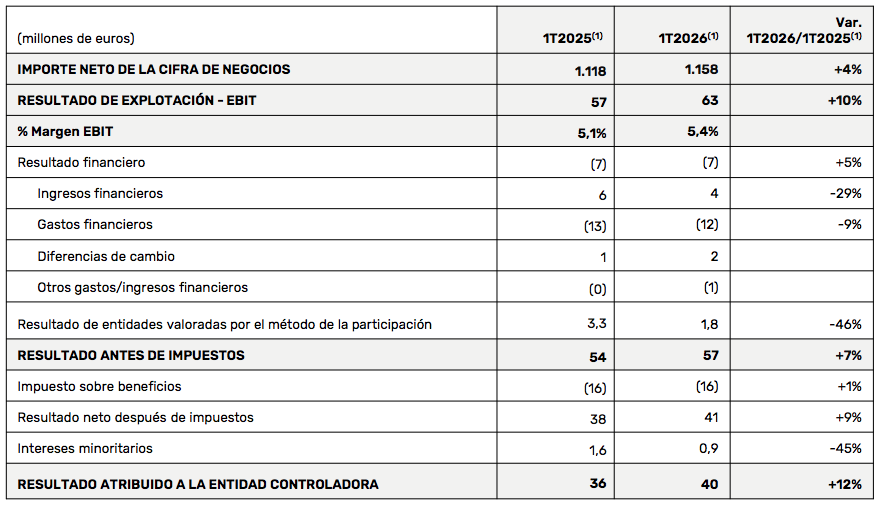
CAF has announced a net profit of €40 million for the first quarter of 2026, representing an 11% increase compared with the same period in 2025.
Construcciones y Auxiliar de Ferrocarriles (CAF) announced its Q1 2026 results on Thursday. The key figures compared with the Bloomberg consensus were: Revenue €1,158m (up 3.6% year-on-year) versus the expected €1,146m; EBIT €63m (up 10.5% year-on-year) versus the expected €62.6m, representing a margin of 5.4% versus 5.5% in 2025 and the forecast. Net profit of €40m (up 11% year-on-year) versus the expected €38.1m.
Notable is the €2,883 million in new orders in January 2026, following the inclusion of the SNCB contract (Belgium), with an initial value of approximately €1,700 million. This represents an order-to-sales ratio (b-to-b) of 2.5x; 3x in Rail and 1.2x in Buses.
This has resulted in new all-time highs in the Order Book, €17.96 billion (up 11% year-on-year), driven in particular by Rail at €15.528 billion (4.7x Sales), whilst Buses reached €2.432 billion (up 3% year-on-year) (2.1x Sales).
CAF has maintained its targets for 2026 of Order Intake/Sales >1x; high single-digit year-on-year sales growth; continued improvement in EBIT margin compared to 2025; stability in the DFN/EBITDA ratio; and a dividend in line with earnings performance.
Bankinter research team’s view:
Q1 2026 results marked by strong order intake and new highs in the order book, following the inclusion of the Belgium contract (over €1.7bn).
Results meet expectations and are on track to meet the full-year targets. Sales growth should improve progressively over the year, as the Rail segment was weaker in Q1 2026 (down 5% year-on-year) compared to the Bus segment (up 35% in revenue), due to accounting effects and some impact on projects from the conflict in the Middle East.
The EBIT margin of 5.4% is slightly lower than that for 2025 as a whole (5.5%). They consider that the conflict has not had a material impact and that their situation differs from that of 2022 (with the war in Ukraine), with a higher level of hedging for energy and raw materials.
In summary, the order book volume provides visibility on revenue growth for the coming financial years. Q1 does not provide a breakdown of margins by business segment; the gradual improvement in margins on project execution would offer further upside potential.


