

Analysis by Morgan Stanley
Investors have expressed some concern about the shift from a ‘tokenmaxxing’ strategy – focused on maximising the use of artificial intelligence (AI) capacity within companies – towards a more cost-disciplined approach, and about the implications this could have for AI adoption.
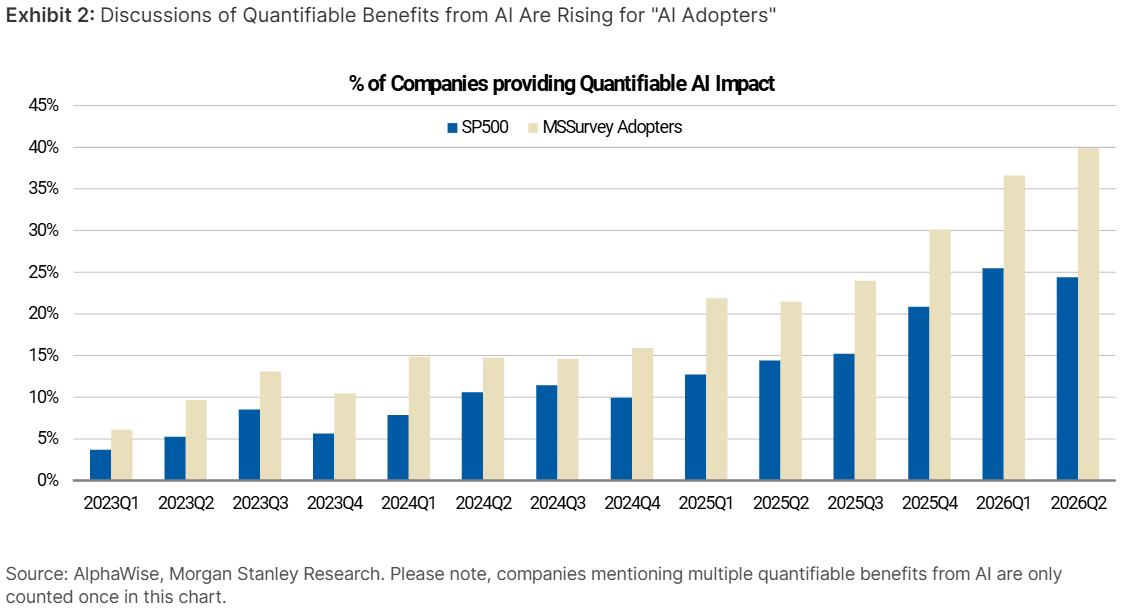
However, companies continue to highlight increasingly visible and quantifiable benefits derived from its implementation. In 2Q26, 40 per cent of companies identified as AI adopters by MS Research cited at least one quantifiable benefit, compared with 37 per cent in 1Q26 and 21 per cent in 2Q25.
Across the S&P 500 as a whole, around 25 per cent of companies reported measurable benefits, compared with 14 per cent a year earlier. Most of these benefits relate to direct financial impacts, revenue growth, the creation of new business streams, cost savings, improvements in capital allocation and productivity gains.
At sector level, Technology continues to lead the way in adoption with tangible results, as 51 per cent of companies in the sector highlighted quantifiable benefits from AI. This is followed by Communications Services (44 per cent) and Financials (37 per cent).
Revenue growth is decoupled from workforce growth
At the same time, although the debate on the labour market implications of AI remains relatively limited, its presence is gradually increasing. In Q2 2026, approximately 10 per cent of S&P 500 companies explicitly addressed the impact of AI on employment, compared with 6 per cent a year earlier, with comments concentrated primarily in the Financial, Technology and Industrial sectors.
Among the companies furthest ahead on the AI adoption curve, this figure rises to 18 per cent, suggesting that workforce-related issues are gaining prominence as implementation matures. The main topics discussed were process automation, a reduced need for recruitment and, increasingly, the decoupling of revenue growth from workforce growth, reflecting the use of AI to boost productivity and generate higher revenue per employee.


