
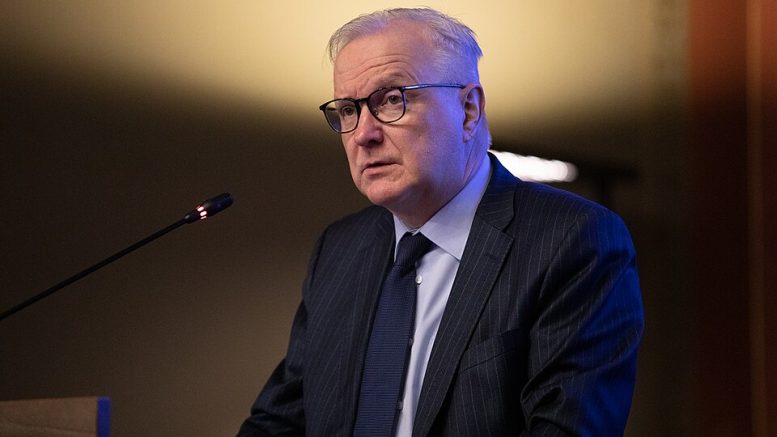
Olli Rehn, Governor of the Bank of Finland, has advocated a fresh push to develop European “safe and liquid assets” to support the euro internationally and lower borrowing costs.
In his lecture “Back to school: Passing Europe’s triple test” delivered during the OMFIF Nordic SSA forum on 19 August in Helsinki (Finland), Rehn stated that “Europe’s funding needs are large or even huge, and our capital markets should better match the scale and needs of the European economy.”
Rehn began by warning that, following the summer break, Europe must face three gigantic structural challenges:
- Defense capabilities: The need to urgently reinforce European security.
- Energy and climate transition: Diversifying energy sources by accelerating the green transition.
- Productivity and innovation: Reversing the productivity gap with the US through investment.
To finance this massive effort, Rehn argued that national public finances alone are not enough and used a football metaphor, noting that “we have good players and strong institutions, but the infrastructure of the pitch (the market) still needs work.” A safe and liquid asset at the European level would deepen and provide structure to the bond market.
Rehn noted that a European “safe asset” could also help reduce capital outflows from European investors to the US—where Europe was effectively helping to finance America’s “exorbitant privilege”—and urged greater pooling of debt issuance and greater clarity about the long-term role of EU debt.
He further referenced OMFIF’s 2026 survey in the Global Public Investor report, where 55% of respondents stated they would increase their euro holdings if the EU became a permanent large-scale issuer. He also highlighted the importance of the ECB’s recently enhanced repo facilities, which allow foreign central banks to access euro liquidity backed by high-quality euro-denominated collateral.
Conscious that developing common European assets through greater joint borrowing is highly unpopular in Germany and several other northern governments, including his own, Rehn underlined: “Sound national public finances remain essential as we develop joint financing instruments.”
However, referring to the need to step up the integration of European financial markets, he affirmed: “We cannot stand still unless we are satisfied with our current irrelevance.”
Rehn, a former European Commissioner for Enlargement and Economic and Monetary Affairs, has headed the Finnish central bank since 2018 and is—after the governors of Luxembourg and Greece—the third longest-serving member of the ECB Governing Council. Rehn sets out to advance the ECB’s intellectual framework in key policy spheres, having already advocated for a modified form of forward guidance regarding interest rate perspectives in an article for the Financial Times on 18 August.


