
Analysis by Aberdeen Investments
Despite the geopolitical turbulence seen in March, global stock markets have, on the whole, maintained an upward trend so far this year. Growth has been driven mainly by emerging markets, which have posted a return of 24.8 per cent, whilst developed markets have lagged behind (as at 31 May 2026). Dividend growth in emerging markets has also generated a compound annual growth rate of nearly 12 per cent over the last two decades. As a result, more than half of companies in emerging markets offer dividend yields in excess of 3 per cent.
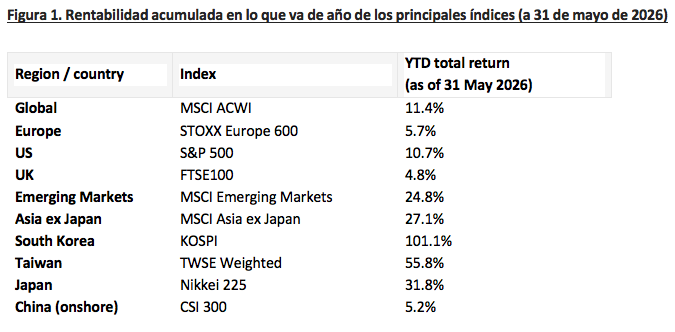
This resilience, driven in part by investor concerns regarding ‘American exceptionalism’ and the excessive concentration of investments in the technology sector, is reflected in investor demand for emerging market equities, particularly within yield-oriented strategies.
Emerging markets: underpinned by fundamentals and rising dividends
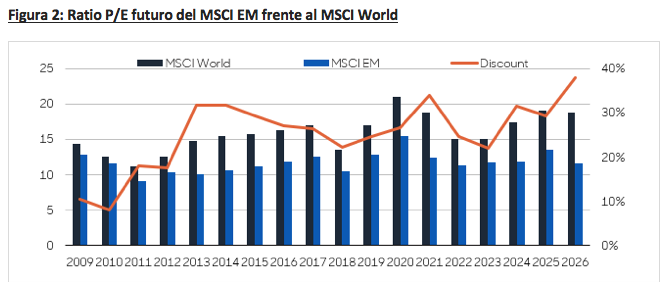
Beyond this year’s strong performance, Aberdeen Investments (‘Aberdeen’) forecasts that emerging market equities will see earnings per share (EPS) growth of 12–15 per cent over the coming cycle, underpinned by a ‘supercycle’ of capital investment set to last for several years and by rising domestic consumption. Emerging market central banks remain in a position of strength, with positive real interest rates, prudent fiscal policies and solid foreign exchange reserves, which are supporting currencies as risk appetite normalises. Valuations also remain attractive, as emerging market equities are trading at a discount of approximately 40 per cent to the MSCI World Index, based on forward price-to-earnings (P/E) ratios of 12 times compared with 19 times⁴.
Asian stock markets: navigating structural shifts
A global restructuring of stock market leadership is underway, with artificial intelligence (AI) driving a shift in the market hierarchy, placing Taiwan and South Korea ahead of several established Western markets. Taiwan has overtaken Canada to become the world’s sixth-largest stock market, whilst South Korea has overtaken the UK and now ranks eighth⁵.
Isaac Thong, Senior Director of Asian Equity Investments at Aberdeen Investments and lead fund manager of the Aberdeen Asian Income Fund Limited, said:
“The rise of Taiwan and South Korea has been driven by their world-class semiconductor ecosystem, which plays a central role in the artificial intelligence investment cycle. However, semiconductor performance is closely linked to global technology demand, and periods of peak profits are often followed by sharp corrections as cycles shift or inventory adjustments take place. Although valuations remain supported by earnings growth, the growing concentration in AI-related stocks is a key risk that investors should monitor.
From an asset allocation perspective, stock selection is crucial. Investors should balance their exposure between high-growth but concentrated markets, such as Taiwan and South Korea, and more resilient, domestically oriented markets, such as China and India.
We remain committed to high-quality companies with strong balance sheets and sustainable competitive advantages. These companies are best placed to weather volatility, reinvest in growth and capitalise on long-term opportunities across the region.