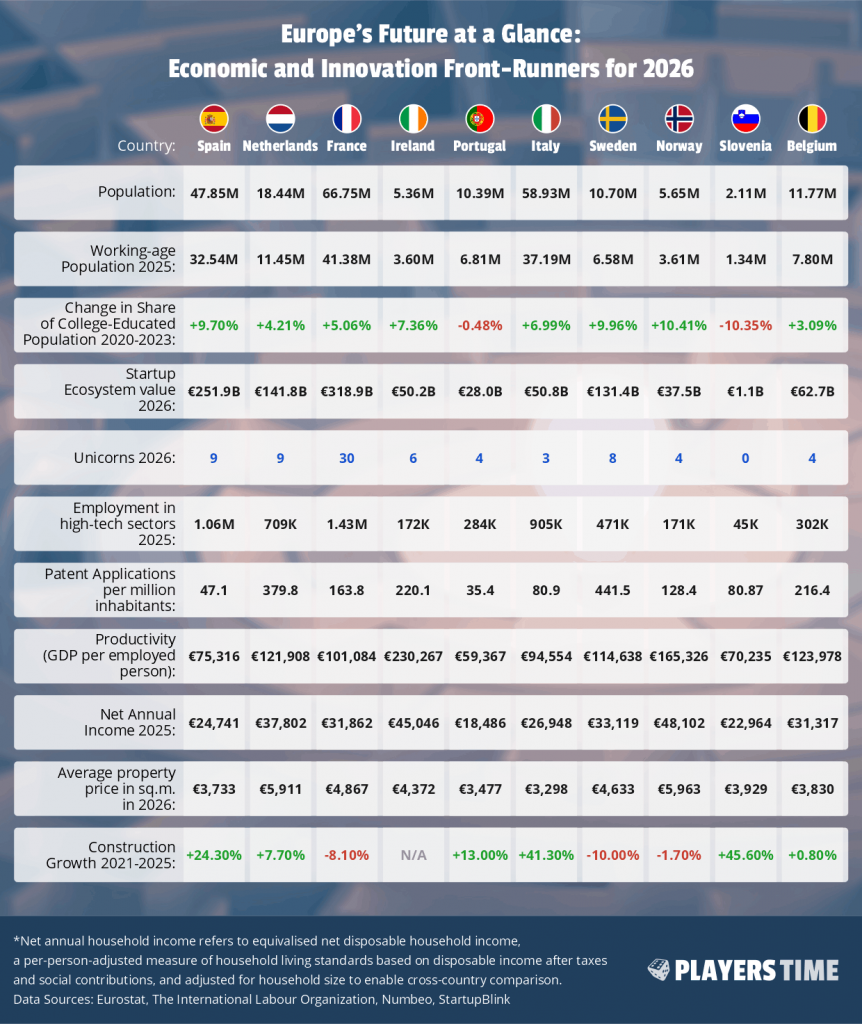

According to a report by PlayersTime, the European labour market is undergoing restructuring, laying the foundations for future growth. Whilst Germany is losing half a million people of working age, the UK is gaining 590,000.
Analysis by Consejeros Editorial Team
Whilst many European countries are struggling to maintain employee productivity amidst summer heatwaves and nationwide strikes, some nations appear to be quietly running out of labour. A recent report by PlayersTime reveals which European countries are discreetly laying the strongest foundations for growth in 2026.
To compile the report, the PlayersTime team analysed 31 European countries based on 11 indicators covering demographics, economic activity, innovation and housing, amongst other factors, in order to assess their performance in recent years and their growth potential for 2026. The full dataset is available via this link.
On the one hand, a group of European countries is seeing its future workforce grow in real time. Malta tops the list with a 2.67 per cent increase in its working-age population (an increase of 10,500 people in a single year), followed by Ireland (1.77 per cent) and Portugal (1.50 per cent). However, the United Kingdom was the country that gained the most working-age residents during the same period: its working-age population grew by 589,100 people between 2024 and 2025.
Meanwhile, several of Europe’s largest and most established economies are heading in the opposite direction. Germany lost more than 425,000 people from its working-age population (a drop of 0.80 per cent), whilst Serbia (a decrease of 41,500 workers) recorded the sharpest decline, at 1 per cent, followed by Romania, at 0.85 per cent (103,000 fewer workers). In total, more than a dozen European countries are currently experiencing a contraction in their core workforce.
Other key findings from the report
At the top of the rankings for working-age population growth, Malta leads the way with a 2.67 per cent increase in a single year, outperforming much larger economies, closely followed by Ireland (1.77 per cent) and Portugal (1.50 per cent). Behind these standout figures lies a dual reality of retention and attractiveness: local residents choosing to stay and invest in their future, alongside a steady influx of newcomers – particularly to Malta and Portugal – drawn by lifestyle benefits such as warmer climates, coastal living and a more relaxed pace of life.
The UK is experiencing large-scale population growth, with an increase of 589,100 people of working age in just one year (up 1.35 per cent). The UK’s working-age population is not only expanding, but doing so in absolute terms that no other country can match. This increase may be linked to the UK’s strong appeal to workers seeking higher wages and a more established labour market. Portugal (up 100,400 people of working age), Spain (up 244,200 people) and Cyprus (up 7,800 people) have seen their working-age populations rise in 2025 following years of demographic pressure. Historically, these countries suffered a significant brain drain, particularly following the 2008 financial crisis, when high youth unemployment and limited career opportunities drove many young professionals to move to more robust economies in northern and western Europe. Regions previously associated with an outflow of talent are now stabilising and, in some cases, beginning to reverse this trend.
Meanwhile, Europe’s largest economy is shrinking where it matters most. Germany’s working-age population fell by half a million people (down 425,800) between 2024 and 2025, marking the sharpest decline on the list. This decline in Germany suggests that fewer people are entering the labour market, whilst younger workers are seeking better opportunities elsewhere.
Serbia records the sharpest decline in its working-age population, with a fall of 1 per cent or 41,500 people by 2025, as young, skilled workers continue to leave in search of better wages and stability, whilst low birth rates and an ageing population exacerbate the situation.