
Search Results for deflation

Japon_dineroTC copia

Japan: An Economy in Need of a Crisis?

Japan’s descent into recession has prompted questions of what the country must do to right itself — and many agree that “Abenomics” will not be enough. Most Japan watchers and economists, and even Abe himself, say that to restore sustainable growth, Japan needs sweeping deregulation and structural reforms. But pushing through such changes is proving daunting, despite Abe’s pledges to “drill deep into the bedrock” of Japan’s vested interests.



bini

“The ECB can implement quantitative easing in a much more aggressive way”

MADRID | January 5, 2015 | By Ana Fuentes | Dissensions at the ECB’s the Governing Council are well-known, and still have a long way to go. While some counselors require a truly expansive monetary policy which helps curbing the deflationary expectations, others deny these latter and therefore refuse to go further and define balance sheet expansion targets. Lorenzo Bini Smaghi, who was Member of the Executive Board of the European Central Bank from June 2005 to November 2011, is among those who believe that the ECB can take much stronger action.


No Picture

2015 Outlook: The year of Equities, the US and Spain

MADRID | By Julia Pastor | The designs of the markets are unfathomable. Mario Draghi might forget the QE idea and the British housing sector might collapse. These are some of the Saxo Bank’s ludicrous forecasts for 2015. A year ago they claimed there would be a default in the Russian debt and the collapse of the oil price, and they were right. Nonetheless, most of the experts that talked to The Corner agree on a scenario for 2015 led by the ECB’s quantitative easing, the oil price reduction and low interest rates.


No Picture

Japan enacts new stimulus plan by €24 bn

MADRID | The Corner | The Japanese government approved last Saturday a new stimulus program to inject up to ¥3.5 billion (€23.8 billion or $29.1 billion), which will help the less developed regions of Japan and the households with subsidies, vouchers for goods and other similar measures. The government of Japan expect this new stimuli plan to boost the GDP by 0.7%. Despite the many critics to the so-called Abenomics program, the measures are still on-going as the advisor to the new government William H. Saito explained in an interview for The Corner.


demand

Mr Sinn on EMU Core Countries’ Inflation

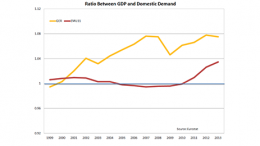
By Franceso Saraceno | Where [President of CESifo Group Hans-Werner Sinn and I] disagree is on how to trigger the demand-driven boom. Mr Sinn expects this to happen thanks to market mechanisms, just because of the reversal of capital flows that the crisis triggered. He argues that the capital which foolishly left Germany to be invested in peripheral countries, being repatriated would trigger an investment and property boom in Germany, that would reduce German’s current account surplus. This and this alone would be needed. Not a policy of wage increases, useless, nor a fiscal expansion even more useless. Problem is, the data speak against Mr Sinn’s belief. Since the crisis hit, capital massively left peripheral countries, and yet this did not fuel domestic demand in Germany.


Saito TN

“People forget that QE is a Japanese innovation”

MADRID | By Ana Fuentes | In a blow to PM Shinzo Abe, the Japanese inflation rate fell to its lowest level in over a year in November (0.7% from a 0.9% rise the previous month, according to government data released Friday), complicating efforts of the central bank to end more than a decade of chronic price falls. Does this mean, as stimulus sceptics put it, that the Abenomics are doomed? Advisor to the new government and one of the 100 Most Influential People for Japan according to Nikkei Business, William H. Saito believes we have been quick to judge their strategy. As he explained to me, they have “many plan B’s left.”


No Picture

Market stress or financial crisis?

ZURICH | UBS analysts | The initial move in oil price was greeted as stimulating growth. The precipitous decline is triggering destabilising factors, especially in EM. As the US economy has accelerated, concern is growing that the Fed is about to shift policy in ways suited to its domestic objectives but not to the needs of increasingly stressed emerging and commodity producing countries and companies. In short, uneven global growth is simultaneously raising the spectre of unsustainable debt deflation across important parts of the (mostly emerging) world and a tightening of US dollar liquidity precisely when it is most needed.


dinero colchon recurso TC

What if QE operates on the supply side and keeps prices low?

WASHINGTON | By Pablo PardoDo you want a Who’s Who of the Republican talking heads? If so, go to this list. Those are the luminaries that asked the Federal Reserve not to go ahead with the Quantitative Easing in 2010, for fear of inflation and currency debasement. Four year later, inflation is nowhere to be seen, and, according to the IMF, the US dollar has strengthened its role in the monetary system. 


Japon recurso1TC

Japanese economy: short-term gain, long term pain?

MADRID | By Luis Arroyo | When many were speaking of a new Japanese recession and the failure of Shinzo Abe’s bold Keynesian policy, his Liberal Democrat Party obtained a sweeping victory at the polls on Sunday. In Europe, the Abenomics are in austerity fans’ crosshairs because if these policies happen to work they would look ridiculous. They were delighted when Japan’s GDP contracted in 3Q. But I’ve been following the Nippon economy for some time and I don’t really rust quarterly figures.