
Search Results for deflation

lupa

Three things to look out for at this weekend’s G20 summit

MADRID | By Sean DuffyThis weekend´s  G20 summit in Brisbane takes place against the backdrop of growing economic uncertainty. With the Eurozone on the verge of deflation, leaders are likely to focus on the ECB´s next move, as the world –and financials– await some tangible prospect of growth outlook. Corporate taxation –brought on the table again after the Luxleaks scandal– and climate change also likely to feature, despite the claims of host Australia


ECB's upcoming tapering

QE fails to work in Europe

MADRID | By JP Marín Arrese The inability to implement a common economic stance aimed at delivering growth and jobs in Europe is putting the onus on monetary policy. The ECB stands as the only hope for redressing a dismal state of affairs. Yet, such high expectations could prove ill-founded. While Draghi saved the Euro’s plight back in mid-2012, he now seems utterly helpless to prevent deflationary bouts looming on the EZ horizon. His quantitative easing (QE) plan, far from achieving its goal, has lost steam. Many observers have put the blame on the ECB’s reluctance to enlarge the asset basket it is currently buying, demanding fully fledged QE, which involves junior debt and sovereigns. Yet, the flaw might lie in Europe’s failure to fully profit from monetary easing.


ReinoUnido contentoTC

UK: let’s be more British, please

LONDON | By Víctor Jiménez Raise the main interest rate? Certainly not. Or not yet, anyway. While the US economy is not showing clear signs of having overcome the assisted breathing phase (i.e. printing money or the recently wound up phase of quantitative easing that the Fed finished two weeks ago), the chances are that the Bank of England will keep the price of the pound at a very low level. 


inflation ECB

ECB endorses balance sheet target

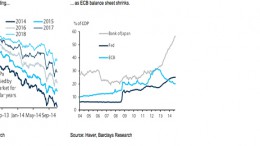
MADRID | The Corner |  As expected, the ECB’s Governing Council left the policy rates and the ABSPP, CBPP3 and TLTRO programmes unchanged and expressed its endorsement for increasing the central bank’s balance sheet to its size at March 2012, that is, around €3Tr. Draghi explicitly pointed out that they would evaluate further measures in case that the current purchase programmes are not enough to expand the balance sheet or if the EZ inflation outlook worsens. With policy rates at the zero bound, pressure is mounting on the central bank to act.


No Picture

ECB: Draghi is bound to act

MADRID | By JP Marín Arrese | Recent events underline the extent to which low confidence is running throughout Europe. The expected upsurge has petered out and investors are losing all faith in political leaders’ ability to redress the situation. As countries seem unable to agree on a joint strategy to foster growth, the onus to achieve this goal increasingly falls on the ECB. Thus, Draghi is bound to act today in order to curb the downward sentiment. Yet, unleashing his firepower over the last months has led nowhere, save for running short on ammunition.


No Picture

EU’s low growth hits financials

MADRID | By JP Marín ArreseCentral banks all over Europe bombastically hailed the stress tests results as solid evidence the banking system enjoyed enviable health. Their diagnosis utterly failed to impress the markets. Ten days later,  financials are plunging to fresh lows as low growth rates signify dire prospects ahead. Investors feel increasingly uneasy faced with dwarfish interest rates and dwindling intermediary receipts, leading to chronic underperformance and under-sized profits. Many fear that an inability to raise their own funds to plug gaps in their balance sheets might weigh on mounting impairment, sending shivers down the spine. Banks may face rough times ahead should deflationary bouts keep the European economy close to stagnation. 


No Picture

BoJ shocks markets; how about the economy?

By Kyohei Morita, Yuichiro Nagai, James Barber, and the CFA at Barclays |  The BoJ shocked the markets with further easing on Halloween. The actual effect on the economy will likely be less direct. The weaker JPY and lower real interest rates have not boosted export volumes and private capex since the start of QQE, and this may not change in the near future. However, consumer spending could draw support from wealth effects and higher wages linked to stronger exporter profits under JPY depreciation


cuentas analisis TC

The ECB’s stress tests deserve praise

MADRID | By Francisco López | Market watchers have something in common with journalists: they prefer criticism rather than compliments –as can be seen from the analysis of the European Central Bank’s stress tests. Criticism is growing, even though markets had already envisaged the results and neither the institution nor Mario Draghi is willing to defend the banking examination.