
Search Results for deflation

DB on Spain

Spain’s lessons to give and learn

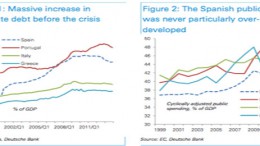
MADRID | The Corner | Assessing Spain’s economic decisions in the years of crisis led Deutsche Bank’s analysts to fix the main five lessons their European counterparts should learn from the country’s experience. One of Madrid’s clearest success was to firstly manage the private sector adjustment  then implement fiscal consolidation. All this would not have been possible without the “crucial”, though sometimes “subtle” support from the EU.

EZ inflation 3

Falling EZ inflation makes it tricky for Draghi

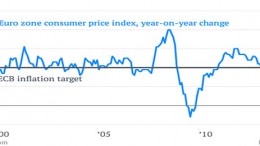
MADRID | By Francisco López | Markets are taking for granted that ECB’s chairman Mario Draghi is going to act tomorrow. What is not that clear is to which extent he will do it. The last inflation figures on the euro area -a greater fall than the expected in May, standing at 0.5% and thus worsening deflation risks- represent a convenient opportunity for those ECB’s members claiming immediate bold measures.


Money supply

Looking forward the ECB’s relief

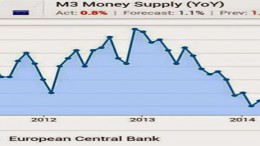
MADRID | By Luis Arroyo | The ECB’s Thursday upcoming meeting will be historical for the EU economy. Any move will mean some easing, even if it will be very difficult that it reactivates the euro zone. What it should definitely do is to massively buy public debt, removing it from financial assets for the banks to find fresh liquid assets as well as capital gains to cover its holes and thus cut interests of private sector’s credit.


No Picture

A busy week ahead with eyes set on ECB

MADRID | By Jaime Santisteban | Stock markets ended May trading high: +3.1% in Spanish Ibex 35 and +2.1% in EuroStoxx. We start a busy week for markets with all eyes set on Thursday’s ECB rate announcement. “The central bank is a slave of its own words and cannot afford to disappoint,” some analysts are pointing out.


No Picture

Money is not long-run neutral or is the CFS’s “divisia” right?

SAO PAULO | By Benjamin Cole via Marcus Nunes’ Historinhas | One of the bromides of modern macroeconomics is that “long-term, money is neutral.” The above maxim makes sense on some levels. A nation is made rich or poor by its investment in infrastructure, education, farmland, factories, work ethics and the like. Running printing presses, per se, is meaningless.


ecb1

Why does the ECB feel so uneasy?

MADRID | By J.P. Marín Arrese | Markets are discounting an easing in European monetary policy in the forthcoming days. Yet, the mood in the ECB is far from cheerful. It feels being dragged into action by political constraints.


No Picture

Draghi highlights credit constraints and risk of disinflationary expectations taking hold

LONDON | By Barclays analysts | ECB is going to cut its policy interest rate and/or announce targeted liquidity measures, with a view to support bank lending at the 5 June Governing Council meeting. In his remarks at the ECB Forum on Central Banking being held in Portugal, ECB President Draghi highlighted the risk of a negative spiral between low inflation, falling inflation expectations and credit for the euro area.


No Picture

IMF’s dual formula for Spanish SMEs: debt haircut & lower wages

MADRID | By Julia Pastor | The key for a Spanish sustainable economic recovery are the country’s SMEs. Considering they mean about 90% of the national corporate landscape, the IMF’s last report on Spain provides two main recipes for helping them survive: extending aids for insolvent companies, which would “preserve Spain’s strong payment culture,” and also increasing wages cuts.


pettis getty d24c7d27 copia

“Spain has been trying to be a good citizen by keeping the German bankers happy”

MADRID | By Ana Fuentes | Well-known U.S. economic theorist and financial strategist Michael Pettis believes the European project has a blatant, simple economic problem: Germany benefits from a weak euro while Spain suffers from a strong currency. As for the IMF’s recommendation of cutting wages in countries like Spain, Mr Pettis thinks it’s an absurd tip that can only make the global demand imbalance worse. He answered our questions via email from Beijing, where he is currently based.


No Picture

Spanish banks mitigate reliance on ECB

MADRID | By Fernando G. Urbaneja | In the midst of the financial turmoil (2012), the ECB facilitated liquidity to avoid the collapse of the European banks when the inter banking market was dried up and nobody lent money. The central bank had to act as “last resort banker” and maintain the system as well as guarantee liquidity. Those credit lines are amortized once their function has been accomplished. Now, they are preparing other measures to stimulate growth and avoid other threats such as deflation or stagnation.