China

alibaba

Alibaba’s big deal

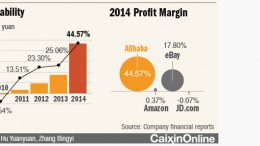
BEIJING | By CaixinE-commerce giant Alibaba Group’s huge initial public offering in New York has stirred the market. Raising US$ 25 billion in total after the company and some of its shareholders sold extra shares, Alibaba’s IPO now ranks as the biggest ever.


No Picture

Air pollution: Time for clean air lobbying

MADRID | The Corner | Around 400,000 people die prematurely in the EU due to air pollution-related problems, costing health systems around €330 billion and €940 billion. Brussels-based non profit EBB (European Biodiesel Board), lobbying for this type of fuel, measured air pollution levels in different areas of the city: they were between 60 and 120 times above considered clean standards. Schadenfreude fans: last year Beijing residents suffered 40 times the recommended maximum exposure limit set by the World Health Organization.


chinese consumer

Deng Xiaoping: A great legacy posing a great dilemma for China

Three decades after admired reformist leader Deng Xiaoping launched his experimental plan of economic reforms, the new Chinese president Xi Jinping is nowadays facing the exact same challenges (and pressures) than his revered comrade. Moreover, Mr Xi’s political survival depends on his ability to earn the trust of the masses and offer them real options for progress. He will have to find a way to do so without tamping the privileges of all those wealthy entrepreneurs who benefited from Mr Deng’s capitalist reforms.


No Picture

China’s antitrust investigation threatening 25% of car industry’s global benefits

MADRID | The Corner | China’s antitrust investigation on over 1,000 manufacturers and foreign suppliers in China (market of € 450,000 million in revenues) threatens 25% of the sector’s global benefits. In particular, German manufacturers are the most exposed (BMW, Daimler, Audi and Porsche generate 50.000 million euros and account for over 80% of demand for luxury goods). According to Morgan Stanley figures, 80% of the market has been influenced by foreign companies. In the short term Morgan Stanley analysts believe the focus of the problem will centre on imports but generalized cuts in luxury markets are also expected.


China's economy slows

China as Responsible Stakeholder or Just ‘Guest’?

Via Caixin | By Miriam L. Campanella | Media outlets have published news that based on a World Bank report China’s economy will be the world’s largest in terms of purchasing parity power (PPP) by the end of 2014. Yet, China itself did not welcome the news. The World Bank included a note in its report that the country’s National Bureau of Statistics contested the methodology and rebuffed the report. The Financial Times even reported how China tried to convince World Bank analysts not to use the data. “China wanted to throw this out,” one source said.


CHINA

Further policy easing to support China’s property downturn

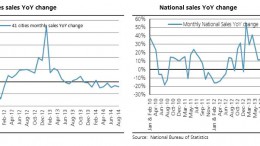
MADRID | The Corner | The biggest uncertainty for China’s economy now and in 2015 is the nature and duration of the ongoing property downturn. Following a sharp drop in the beginning of 2014, Chinese property construction has shown signs of improvement in recent months as policies have been increasingly relaxed. Both have provided support for the economy and property related stocks, with the latter rallying by 17% from trough levels. However, UBS analysts expect that the property downturn will weigh more heavily on growth in Q4 and 2015.


No Picture

Stock markets go up despite poor global macroeconomic data

MADRID | By J. J. Fdez-Figares (LINK) | European and American stock markets closed yesterday up in a session of low activity and  volatility. The good performance of Western stock markets ​​occurred despite the set of macroeconomic figures published during the day in China, Europe and the USA, which pointed again to a global slowdown in economic growth. The only explanation we can find to the good performance of stock markets yesterday is precisely that investors have interpreted that as long as the growth of these economies remain weak, the central banks will be forced to maintain its current policy of monetary expansion, which provide liquidity to the system, something that equity markets consider positive.