

ECB

No Picture

Jackson Hole: Without inflationary pressures on the horizon

MADRID | The Corner | Central bankers are meeting this week in Jackson Hole to talk about employment and its weakness in general terms. Unlike what is happening in Europe, US and UK are seeing improvement in employment (their unemployment rates have decreased from 10% to 6.2% and from 8.4% to 6.4%, respectively) with the curiosity that they’re not coming with wage increases. In fact, last British data shows the first fall since 2009. This circumstance means less inflationary pressures, therefore Bankinter analysts think that central banks will not start to tense its monetary policy until wages begin to invigorate, something that will take some months to arrive.


ecb1

ECB under pressure, markets demand QE policy

MADRID | The Corner | The European weak economic growth increases the pressure on the ECB to take additional measures or the long-awaited QE to boost growth, beyond those already announced in June and of which the effects probably will not be seen until 2015. At the moment the ECB in its monthly report reemphasized that there is “a continued moderate and uneven recovery of the euro area economy”, with low inflation rates and a weak monetary and credit evolution. At the same time, inflation expectations for the euro area in the medium and long term remain firmly anchored in line with the ECB’s target of keeping the inflation rates at levels below but close to 2%.


No Picture

EZ investor confidence dropped to its lowest level in a year

MADRID | The Corner | The Eurozone Sentix Index fell 2.7 points in August, its lowest level in a year, from 10.1 reached in July. The analysts’ consensus had expected that the indicator would go back to 9 points. Sentix attributes in a press release this decline to the approved economic sanctions against Russia and points out that “As this slump derives from an event which is subject to politics and power play, the central banks, particularly the European Central Bank, will have difficulty in trying to counter this.”


No Picture

BCE: Widespread decline in interest rates of banking corporate credit

MADRID | The Corner | The ECB reported on Thursday the data of interest rates applied in banking corporate loans in June, which have been reduced by 18 bp in loans worth up to €1M for the EZ (up to 3.57%). Moreover, these discounts have been widespread and even higher in peripheral economies’ banks: -21 bp up to 4.3% (weighting by GDP of rates applied in Spain, Italy, Ireland and Portugal).


No Picture

ECB: credit standards on EZ loans eased for the first time since 2007

MADRID | The Corner | A further sign of a recovery in credit: standards on loans within the eurozone have been eased for the first time in the 2Q in seven years, just before the financial crisis bursted, the ECB said in its regular Banking Lending Survey released on Wednesday. Net demand continues to recover for both household and enterprise borrowing. However, as we reported, the open bar announced by Mr Draghi won’t have an impact on loans until 2015 and, meanwhile, credit fall continues to accelerate in some peripheral countries, especially in Spain and Italy.


No Picture

The (bonds) Hunger Games

MADRID | The Corner | In the next few days demand for Spanish bonds is expected to grow, since Spanish debt auctions will be held and European CPI data showing that prices remain very low will be released.


govies

EU banks reach debt holdings all-time high

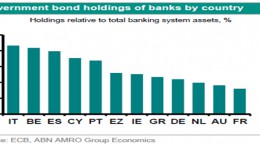
MADRID | The Corner | European banks have increased their holdings of govies in June by +0.1% m/m (+1.4% y/y), with one somewhat higher increase in the periphery (+ 0.6% m/m and – 1.2% y/y), mostly of a +8.6% in Ireland and +1.8% of Portugal. According to the ECB, EU lenders have reached a new all-time high of 1.8trn debt holdings, while peripheral banks are approaching 2013 numbers (€830bn vs €840bn in June 2013).


No Picture

ECB: AQR results will be included in stress tests

MADRID | The Corner | ECB’s upcoming stress tests will have have the AQR findings incorporated (the so-called “join-up”), an element that was previously missing. And banks will be informed of the full and final results only shortly before they are communicated to the markets, as the central bank published on Thursday