

Europe

No Picture

How to solve the problems of Europe’s second biggest economy

John Bruton | I recently attended a conference that looked at France’s domestic economic situation, and the impact that has on the country’s global and European role. According to budgets published in October, France and Italy are failing to meet the eurozone’s requirements for reducing government debts and deficits to sustainable levels.
No Picture

What are asset prices telling us about growth and inflation?

LONDON | By Keith Parker at Barclays | The recent risk aversion episode has raised concerns that global growth and inflation are continuing to fall. While the collapse in oil is flashing red, copper prices and industrial metals have had a more measured decline. Copper has historically been a good barometer for global production and is pointing to continued sluggish growth, but not another leg down. 


No Picture

Is Europe contagious?

ZURICH | UBS | The impact of an EU slowdown on US growth would be minimal: US exports to the EU are a small proportion of GDP (2.8% in 2013), and the secondary effects—the impacts on major US trading partners’ incomes and import demand—are even smaller. For example, a hypothetical 1 percentage point slowing in EU real GDP growth would likely translate into only a 0.1 pct pt drag on US real GDP growth via weaker exports to the EU and to other US trading partners affected by the EU slowing.


No Picture

Europe: Calling a spade a spade

SAO PAULO | By Marcus Nunes via Historinhas | Tim Worstall comes out and calls a “spade a spade” in “Europe Doesn’t Have A Debt Crisis, Europe Has A Monetary Crisis”: The stock markets plunge over concerns about the eurozone; there’s a flight from lower quality sovereign bonds; Greek, Spanish and other periphery bond yields spike. It looks like the eurozone debt crisis is back. But this time around we really should get to grips with the fact that what we’ve got here is really not a debt crisis.


No Picture

US Investors: Biggest net selling of Europe since 2008

ZURICH | By UBS analysts | Global investors have been big sellers of Europe ex-UK equities in September and also the last 12 weeks (Figure 1). And this doesn’t include the heavy sell-off in the last week. US Treasury data shows that US-based investors were net sellers of $14.3bn in June–the biggest month of selling since the collapse of Lehman’s in 2008. How far through the current correction are we? So far the European market is down 8% from its September peak–in-line with the average of 9.5% in Bull market corrections since 1975.


No Picture

Inflation: A monetary cancer metastasizes in Europe

VIENNA | By Keith Weiner via Truman Factor | The European Central Bank again cut the interest rates it controls. Notably, the deposit rate was moved deeper into negative territory. It is now -0.2% (minus 20 basis points, that is not a typo). The ECB says it’s trying to nudge prices higher, but it’s actually feeding the cancer of falling interest. The linked article above, like most, is focused on the quantity of euros and the presumed direct relationship to price. The following bit of editorializing from that article is uncontroversial in Frankfurt, London, New York, Mumbai, or Shanghai.


draghi

Why ABS drive will fail, Barclays reckons

MADRID | By Alberto Vigil at Barclays | The ABS purchases by the European Central Bank will not work basically because it is necessary for a regulatory change that does not penalise (in capital terms) either banks or insurance companies who have those securities. That is, if the ECB’s intention is to increase the amount of credit in the real economy, then it should have two specific goals: first, spreading the risk that banks assume when they provide credit; second, reducing banks’ costs of financing.


Economic sentiment indicator

Economic sentiment worsens in Italy, Germany and France, but remains stable in Spain

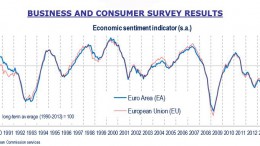
MADRID | The Corner | In August the Economic Sentiment Indicator (ESI) fell in the euro area (by 1.5 points to 100.6) and the EU (by 1.2 points at 104.6). Once again the core Europe does not bring any good news, where sentiment dropped in Italy (by 4.1p to 97.8), Germany (by 1.9p to 104.1 ) and France (by 0.6p to 95.1), while sentiment remained flat in Spain (103.).  Among the data published by the European Commission today, the industrial confidence fell in the EA to -5.3 in August from -3.8 in July and construction sentiment dropped to -28.4 from -28.2. Sentiment in the services industry declined to 3.1 from 3.6 and retail trade to -4.6 from -2.3. Consumer confidence remained at -10.


No Picture

ECB stimulus speculations keep circulating

MADRID | The Corner | The expectation that the ECB will finally announce a QE program after Draghi’s words at Jackson Hole and the confirmation that the ECB would have hired Blackrock for advice on launching a ABS program continue to nurture the Eurozone bond rally and thereby the credit one. Yesterday many bond markets in Europe returned to record lows with improvements in 10 years of 3bp (Germany), 2.5bp (Spain) and 2bp (Italy).


No Picture

A QE would be key for Germany, France and Italy to overcome their current stagnation

MADRID | By Francisco López | Are there reasons for such optimism after Draghi’s words in Jackson Hole? Yes, but only if Draghi dares to execute a program of sovereign debt purchases immediately. It happens that not all experts are clear that it will be the case. Especially, because the package of measures adopted by the ECB in June has still not been implemented: two TLTROs auctions and the Asset-Backed Securities (ABS) program. Would it not be better to wait to check the effects of these measures?