
Germany

No Picture

Germany is already being paid for borrowing

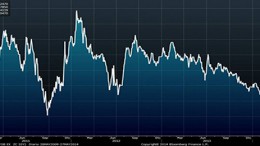
MADRID | By Bankinter analysts | Bundesbank’s monthly bulletin points that the German economy might slow down in the 2Q14, but that it would be reactivated in the 3Q14 thanks to the construction industry and the improvement of the confidence amongst households. Thus, the central bank raised its forecast for 2014 from 1.7% to 1.9%. In this context, Germany sold €1,511 million in 6-month bills with a negative interest rate: -0.0015%. Last May, the same bills were sold at +0.1089%, so we may conclude that the ECB’s negative deposit rate also helps the German debt.

pettis getty d24c7d27 copia

“Spain has been trying to be a good citizen by keeping the German bankers happy”

MADRID | By Ana Fuentes | Well-known U.S. economic theorist and financial strategist Michael Pettis believes the European project has a blatant, simple economic problem: Germany benefits from a weak euro while Spain suffers from a strong currency. As for the IMF’s recommendation of cutting wages in countries like Spain, Mr Pettis thinks it’s an absurd tip that can only make the global demand imbalance worse. He answered our questions via email from Beijing, where he is currently based.


ecb

EU’s problem is not in Germany but in France

MADRID | The Corner | The rise of the far-right Front National will harm more the European project than any economic recipe imposed from Berlin. In the end, Germany is indeed setting hard conditions for the EU integration, but at least is favoring it, whereas France’s Marine Le Pen has a clearly anti European speech and intends to bring power back to the countries.


germany's market-focused?

Is Germany the euro’s owner?

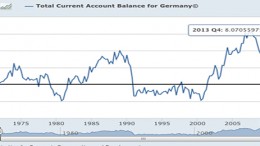
MADRID | By Miguel Navascués | Nobody questions Germany’s big efforts in the EZ, but Spain accumulates an external debt of 100% of GDP as Germany accumulates capital abroad amounting for 100% of its. When a country does not cease to make external surpluses, it generates parallel deficits in others. These gaps are corrected by means of a rate exchange appreciation- depreciation or by reinvesting the surplus in the countries in deficit. Neither of which is happening today.


No Picture

Germany and Spain push EZ up

MADRID | By Julia Pastor | Germany and Spain are leading the Euro zone’s economic recovery from the EZ’s North and South, respectively. 1Q14 data point out the German economy grew by 0.8% and Spanish by 0.4%, while France’s GDP was flat and Italy, Portugal and the Netherlands went back to recession. Merkel’s following the EC recipes to increase wages and Rajoy’s reforms -despite a big, painful impact on the Spanish population- seem to have bear fruit.


No Picture

Time for ‘Draghilogists’

FRANKFURT | By Lidia Conde | Experts don’t agree about what can happen in the short and medium term in the Eurozone. The main critical voice is the president of Munich’s Ifo Institut, Hans-Werner Sinn, who believes that Europe is in a “resting phase” before the storm hits again. According to Germany, now is the time of the “Draghilogists”, i.e. those analysts who try to elucidate the ECB’s next step.


energy prices

Industry wins in Germany’s energy transition

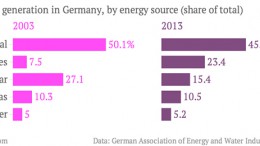
BERLIN | By Alberto Lozano | The German ambitious switch from nuclear and carbon-based energy toward renewables remains the biggest challenge for the first EU economy. The country’s industrial sector and consumers are worried about how much they will have to pay in terms of prices, competitiveness and jobs.


boy combing hair

Stress tests: EU banks start tarting up

MADRID | By Julia Pastor | As the ECB’s crucial examination comes closer, all European entities, from the core to the periphery, have started studying different formulas to show the best capital ratios possible. German banks would imminently issue CoCos, while Italy’s could be about to create a joint bad bank and Spain is to monetize around €40 bn of deferred tax assets. The stress tests’ results will be released at the end of October 2014.


Euelections

EURO ELECTIONS: Germany will win, no matter what -but does it care?

BERLIN | By Alberto Lozano | The upcoming EU elections (May 22-25) arrive in a moment of enormous challenges for the Union. What happens in the next months can change definitely the political and economic landscape. Again, Germany plays the main role with its 67 million of voters and the two ‘frontrunners’ supported by the two big parties from the German Coalition. However, 72% of its citizens have low or no interest in the polls.