
Greece

tightening greek belt austerity financial crisis

The politics of debt dynamics in Greece

ATHENS |  By Jens Bastian via MacroPolisThe reprofiling of Greece’s sovereign obligations makes any future debt restructuring an exercise that would almost entirely impact the official sector of Greece’s international creditors. Among these creditors, European institutions such as the ECB, the EFSF and eurozone member states would be affected most prominently.
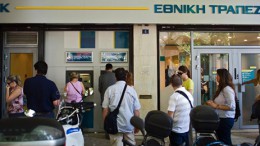



greek banks

Greek banks may soon breathe sigh of relief on capital needs

ATHENS | By Manos Giakoumis via MacroPolis | Greek banks are always at the forefront of domestic market developments. Despite the strong rebound of 6.4 percent on Friday, their shares still recorded cumulative losses of 7.8 percent last week and 23.9 percent over the past three months. Concerns about the outcome of the upcoming comprehensive assessment European Central Bank are one of the key factors weighing on investors’ minds. 


No Picture

Greece: ‘We’re dying to pay our taxes’

ATHENS | By Damian Mac Con Uladh at The AgoraLike thousands of citizens, Nikolas Elliniadis had left it to deadline day to go to his bank, in Thessaloniki, Greece’s second city, to pay the first of six instalments of Greece’s new property tax, the latest levy to hit a population beleaguered after five years of austerity.


No Picture

Greek debt viable, no haircut needed

MADRID | The Corner | As Greece and its euro-area creditors meet on Thursday to review its progress ahead of another round of talks on repayment terms for its public deb, the worst for Athens seems to be over. The Mediterranean country doesn’t need a haircut, its debt is sustainable, as head of the EFSF ESM Klaus Regling commented in Brussels on Tuesday. However, and despite the profound, painful reforms the country has been through, recovery is hampered by private debt of households and companies: about 164 billion euros ($208 billion), 90% of GDP.


No Picture

Does Greece need a third programme?

By Jens Bastian via MacroPolis | During his visit to Berlin this week, Prime Minister Antonis Samaras repeatedly emphasised that Greece does not require a third financial support programme. In his conversation with Chancellor Angela Merkel he highlighted that the Greek sovereign was able to successfully return to international bond markets in April after a three-year forced hiatus.


No Picture

Change of pace in Europe: Spain, Portugal, Ireland and Belgium will lead growth between 2015 and 2016

MADRID | By Julia Pastor | ECB’s Mario Draghi brought put the bleak panorama that the Eurozone’s economy is facing on the table, and we saw it again reflected in the not-so-promising September manufacturing PMI. The index came in at 50.5 compared to 50.7 in the prior month, whereas EZ Services PMI accelerated at 52.8 for September versus 53.1 in August. Even the composite index plummeted to its lowest fee in the last nine months and reached 52.3. In Germany, both manufacturing and services indexes have also decreased; while in France only manufacturing improved, although it is still contracting.


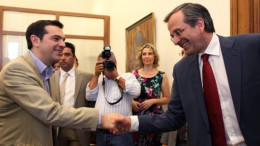
greek politicians

Run this way: The recurring pattern of Greek leaders

ATHENS | By Nick Malkoutzis via MacroPolisAs the Greek general elections of May (and then June) 2012 approached, every poor unfortunate European politician attempted to grab a moment in the spotlight by pontificating on whether Greece should or should not be in the single currency. While the euro vultures picked at Greece’s carcass, thousands of fear-stricken Greeks withdrew their money from local banks. Who knows, maybe in our strange world of acute fiscal adjustment and extreme political polarisation it is a sign of progress that Greece no longer needs foreigners to encourage a bank run. Local politicians can do the jobs themselves.


No Picture

Greece: Survey finds 2013 household budgets devastated, inequality persists

ATHENS | By MacroPolis | The impact of austerity measures on Greek citizens has been devastating, according to the last official dataThe average monthly expenditure of households dropped 7.8 percent year on year (YoY) to 1,509.39 euros in 2013, according to the 2013 Household Budget Survey published by the Hellenic Statistical Authority (ELSTAT).


No Picture

Tsipras starts to flesh out SYRIZA’s economic policy but questions remain

ATHENS | Via Macropolis | In a much-anticipated speech, SYRIZA leader Alexis Tsipras unveiled the main pillars of his party’s economic policy platform on Saturday, focusing on debt relief from the eurozone, the use of European Union funds to boost employment, a reduction in taxes and an increase of wages and pensions.