Greece

No Picture

Troika inquiry in Greece: talk to the organ grinder, not the monkey

ATHENS | Op-ed via The Agora | The European Parliament’s inquiry into the troika and its record in eurozone bailouts sounds like a welcome effort to hold Europe’s crisis managers to account. Unfortunately, the inquiry’s report is likely to miss the bigger picture, because of the European Parliament’s institutional navel-gazing and narrow focus on the troika – a team of civil servants – rather than its political masters.


Greece's accounts

Greece: It’s not the distance; it’s the load you carry

ATHENS | By Yiannis Mouzakis via Macropolis| It is beyond any doubt that what Greece has achieved fiscally over the last few years is phenomenal. A primary deficit that at the end of 2009 stood at 24.2 billion euros has been wiped out within just four years and has been turned into a small primary surplus, irrespective of any objections one might have about its size and how it was achieved.


No Picture

Greece: The improving economy supports a government already in combative mode

LONDON | By Fabrice Montagne at Barclays | Recent economic data suggest that Greece’s economy is improving. While this is not enough to change our current cautious growth forecasts, it does provide some support for the government as it enters a very difficult period, having assumed the EU presidency, and faces troika negotiations and domestic political opposition.


No Picture

What do EBA tests reveal, or fail to highlight, about Greek banks?

Macropolis | The European Banking Authority (EBA) disclosed on December 16 the results of a transparency exercise covering 64 European banks from 21 countries. The aim of the exercise was to share updated information based on first half 2013 data about banks’ operations according to uniform benchmarks.

The European Banking Authority (EBA) disclosed on December 16 the results of a transparency exercise covering 64 European banks from 21 countries. The aim of the exercise was to share updated information based on first half 2013 data about banks’ operations according to uniform benchmarks. – See more at: http://www.macropolis.gr/?i=portal.en.economy.699&itemId=699#sthash.rawJn6MF.dpuf

Greece Debt 2013

Debt relief or debt restructuring for Greece?

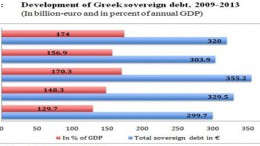
By Jens Bastian at The Agora | The two economic adjustment programmes for Greece from 2010 and 2012 as well as the sovereign debt restructuring from April 2012 and the debt buyback initiative in December of the same year have had a significant impact on the debt profile of Greece as a sovereign debtor. Greece’s creditor structure in 2013 compared to the point of departure in 2010 hardly bears any resemblance.

adjustment programmes for Greece from 2010 and 2012 as well as the sovereign debt restructuring from April 2012 and the debt buyback initiative in December of the same year have had a significant impact on the debt profile of Greece as a sovereign debtor. Greece’s creditor structure in 2013 compared to the point of departure in 2010 hardly bears any resemblance. – See more at: http://www.macropolis.gr/?i=portal.en.the-agora.672&itemId=672#sthash.BZtuYz92.dpuf
The two economic adjustment programmes for Greece from 2010 and 2012 as well as the sovereign debt restructuring from April 2012 and the debt buyback initiative in December of the same year have had a significant impact on the debt profile of Greece as a sovereign debtor. Greece’s creditor structure in 2013 compared to the point of departure in 2010 hardly bears any resemblance. – See more at: http://www.macropolis.gr/?i=portal.en.the-agora.672&itemId=672#sthash.BZtuYz92.dpuf

The two economic adjustment programmes for Greece from 2010 and 2012 as well as the sovereign debt restructuring from April 2012 and the debt buyback initiative in December of the same year have had a significant impact on the debt profile of Greece as a sovereign debtor. Greece’s creditor structure in 2013 compared to the point of departure in 2010 hardly bears any resemblance.

– See more at: http://www.macropolis.gr/?i=portal.en.the-agora.672&itemId=672#sthash.BZtuYz92.dpuf


The two economic adjustment programmes for Greece from 2010 and 2012 as well as the sovereign debt restructuring from April 2012 and the debt buyback initiative in December of the same year have had a significant impact on the debt profile of Greece as a sovereign debtor. Greece’s creditor structure in 2013 compared to the point of departure in 2010 hardly bears any resemblance.

– See more at: http://www.macropolis.gr/?i=portal.en.the-agora.672&itemId=672#sthash.BZtuYz92.dpuf


euro greece1

The euro debate Greece is not having

LONDON| By Yiannis Mouzakis via The Agora | You may be amongst those who are not convinced of the devastating effect that the policy mix and pace of fiscal contraction in Greece is having on society. If so, you may subscribe to the official line trotted out by the country’s lenders that the program is helping the country regain competitiveness and the economy fix its external imbalances. This is the greater cause that is demanding such a sacrifice. There is no gain without pain, goes the argument.


No Picture

Greece and the Euro: Syriza, the last man standing

ATHENS | By Nick Malkoutzis at The Agora | Until a few days ago the only thing connecting SYRIZA and Texas was the lone star on their flags. But, suddenly, the US’s second-largest state seems to have provided a defining moment for Greece’s second-largest party. SYRIZA leader Alexis Tsipras chose a speech at the University of Texas in Austin on November 4 to put minds outside of Greece at ease with regard to his party’s plans should it come to power after the next general elections.


Greeces budget deficit No one is listening

Greece’s budget deficit… no one is listening

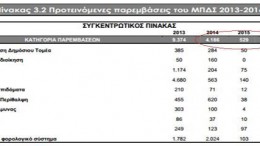
ATHENS | By Ilias Makris via Preseurop | “Help!” Arriving in Athens on November 5, representatives of the EU-ECB-IMF troika met with the Greek Minister of Finance, Yannis Stournaras. Their meeting focused on the the question of the country’s budget deficit in 2014 along with measures to ensure its compliance.


Greek Banks2

When Will Greek Banks Operate as Credit Institutions Again?

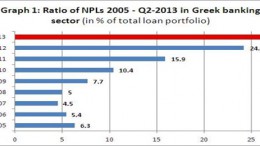
ATHENS | By Jens Bastian via The Agora | Despite the successful recapitalisation process and continued restructuring of the Greek banking sector, the credit transmission mechanism towards the real economy remains severely impaired.  [Above graph sources: The Agora and Bank of Greece yearly data.]


Greece

Greece: Ladies and Gentlemen, Please Fasten Your Seat Belts

By Nick Malkoutzis | The Agora/ MacroPolis | Earlier this year, Prime Minister Antonis Samaras held an informal dinner with some of his party’s MPs. He reportedly told them that if Greece would be able to get through a tough summer, it would “take off” in September. We are now nearing the end of October and there has been no departure for the skies. Instead, Samaras is bracing for impact.