
inflation

No Picture

Fed, beware of the inflation!

SAO PAULO | By Marcus Nunes via Historinhas | In The Risks to the Inflation Outlook SF Fed researcher Vasco Cúrdia writes: the median inflation forecast is not expected to return to the FOMC target of 2% until after the end of 2016. The uptick in inflation in the first half of 2014 could lead one to believe inflation is finally on the path back toward its target. However, inflation has shown similar patterns several times before and each time the uptick has never lasted very long. According to this model, we should not see inflation begin to recover more firmly until around the end of 2015.


No Picture

Deflationary risk: Which countries are most likely to be impacted?

MADRID | The Corner | In a report by Atradius Credit Insurance, they say that the disinflationary trend is visible across the Eurozone, but not all countries are expected to face the same issues. Countries that have a large output gap and those that still have to implement the most reforms will face the highest disinflationary pressure. To create a list of the countries most likely to be impacted, we first select the Eurozone markets that have a budget deficit larger than 3.0%, as these are subject to the Excessive Deficit Procedure which forces them to implement fiscal and structural reform.


inflation ECB

ECB endorses balance sheet target

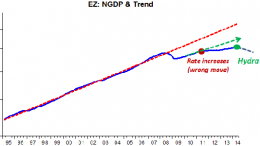
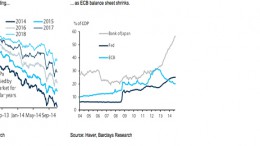
MADRID | The Corner |  As expected, the ECB’s Governing Council left the policy rates and the ABSPP, CBPP3 and TLTRO programmes unchanged and expressed its endorsement for increasing the central bank’s balance sheet to its size at March 2012, that is, around €3Tr. Draghi explicitly pointed out that they would evaluate further measures in case that the current purchase programmes are not enough to expand the balance sheet or if the EZ inflation outlook worsens. With policy rates at the zero bound, pressure is mounting on the central bank to act.


No Picture

What are asset prices telling us about growth and inflation?

LONDON | By Keith Parker at Barclays | The recent risk aversion episode has raised concerns that global growth and inflation are continuing to fall. While the collapse in oil is flashing red, copper prices and industrial metals have had a more measured decline. Copper has historically been a good barometer for global production and is pointing to continued sluggish growth, but not another leg down. 


bancos crisis TC

Are global growth fears over-stated?

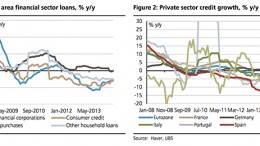
MADRID | The Corner | Gloomy inflation data in the eurozone prompted a debate about recovery losing momentum. But while tackling disinflation should be a priority, we shouldn’t be too worried about growth.  “Leading indicators of growth are not – at present – consistent with any major slowdown in the world economy. Indicators of financial and monetary conditions and many industrial metal prices are relaying a similar message,”analysts at UBS commented on Thursday. 


inflation eurozone

Stimulus, bitte!

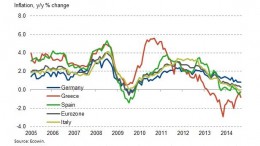
MADRID | The Corner | The eurozone’s inflation slipped in September to its lowest level since October 2009 (0.3%), raising fears of an eventual third recession in six years. Prices have been now been in the ECB’s “danger zone” of below 1% for 12 consecutive months. And yet Germany, the biggest economy in the EZ,  is torn between deficit control and growth, relieved with a weak euro helping its exports but worried about the same depreciation policy leading to less pressure to implement reforms in countries like France.


china market

Inflation in China falls further amid lower commodity prices

HONG KONG | From Barclays analysts | China inflation fell further in September, to 1.6%, below consensus (1.7%), but in line with our forecast. The key downside drivers were lower commodity prices, and declining food inflation. Inflation has now fallen to its lowest levels since January 2010, a 56-month low.


ECB1

ECB: More questions than answers

MADRID | The Corner | The ECB disappointed all those who were keen to gain more concrete information on how it wants to expand its balance sheet over the coming months. Instead, Mr Draghi pointed out that inflation expectations, not balance sheet size, remain the ultimate yardstick of current and future ECB action. “We think this is the right communications strategy as we had become concerned that the ECB would set fairly explicit balance sheet targets that it might struggle to attain. The ECB offered a more cautious assessment of the growth and inflation outlook and left the door open for additional unconventional measures. Nevertheless, our base case scenario remains that sovereign QE will not be triggered,” UBS analysts commented.