
Reported by Julia Pastor
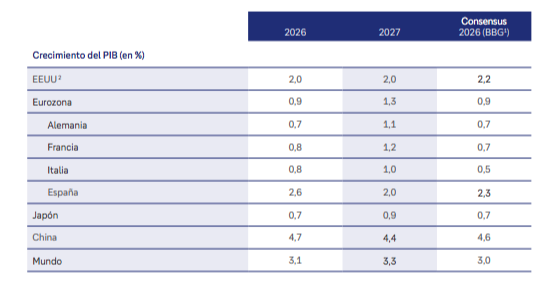
Of the four major economies in the Eurozone, Germany will see the lowest growth in 2026 and Spain the highest, according to Deutsche Bank’s growth forecasts. 0.7% compared to 2.6%. Italy and France will both grow by 0.8%, and the Eurozone as a whole by 0.9%.
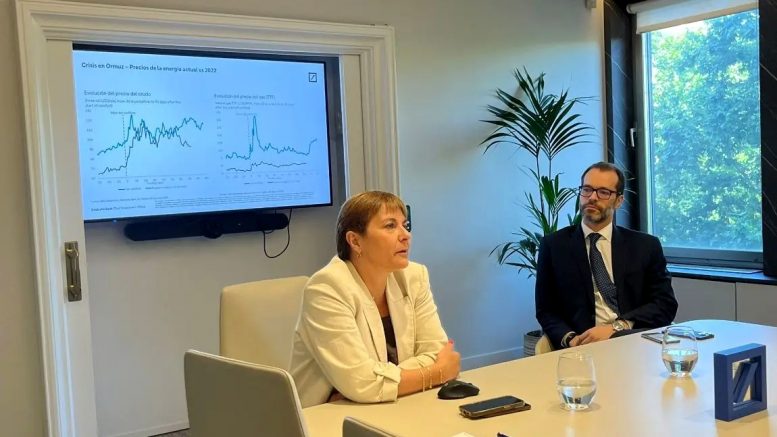
Germany is the country for which the research firm has revised growth expectations downwards the most, as it is the most industrialised economy and, consequently, the one bearing the highest energy costs. Conversely, Spain owes its better position to its particular focus on the services sector – not just tourism – and on exports. It is also due to an energy mix in which renewables play a leading role. According to Rosa Duce, Chief Investment Officer in Spain, “Germany will manage to offset its lower growth thanks to the fiscal package”. Regarding Spain, she explains that “the economy’s problems remain the same despite it having established itself as the driving force of the Eurozone: the imbalance between supply and demand in the property sector and low productivity”. The lack of a budget, however, is not a problem, as “Spain is generating revenue precisely because of this expansion”.
MACROECONOMIC FORECASTS
Inflation will remain high. The Eurozone CPI could peak at over 4% in the summer and close 2026 at 3.1%. “There’s no need to panic. It will be a temporary shock.”
Meanwhile, equity markets will maintain an upward trend, supported by corporate profits, particularly in technology and AI. Alejandro Vidal, Head Investment Manager at Deutsche Bank, explains that “the stock market simply reflects the dynamics of the global economy, with technology and AI acting as structural catalysts”.
The outlook for oil prices is one of “tense calm”. The bank forecasts that they will gradually return to pre-Iran conflict levels and that the risk premium on crude will remain in place at least until after the summer. Prices are expected to hover around $80 a year from now.
Finally, the trend towards de-dollarisation will resume once peace in the Middle East is secured, favouring gold, which is set to regain its pre-crisis role as a speculative asset. Gold prices could reach $5,400 per ounce by June 2027.
As the 60-day period unfolds to see how the 14 points of the preliminary peace agreement between the US and Iran play out, and with significant uncertainty surrounding the future of the nuclear programme, Deutsche Bank expects market volatility.


