
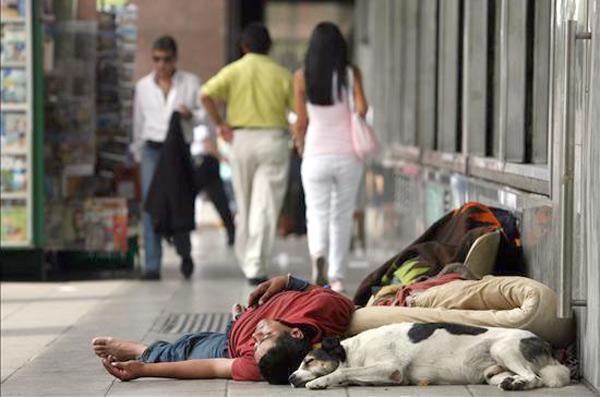
Aurelio Medel | The 2025 Living Conditions Survey, recently published by the INE (National Statistics Institute), clearly demonstrates how the improvement in macroeconomics is failing to reflect in the lives of families. The Government rightfully boasts that Spain is the fastest-growing economy in the EU (2.9%), with more people employed than ever (22.5 million), an unemployment rate below 10%, and a minimum wage that has risen by 61% (2018–2025). However, the percentage of the population at risk of poverty or social exclusion has stagnated over the last four years at around 26%, although it has dropped two points in a decade, from 28.8% to 25.7%.
This means that there are 12.7 million people in a critical situation in Spain, according to the INE. This figure is similar to the latest Foessa/Cáritas Report, which pointed out that 4.3 million people are in severe poverty and another 9.5 million face persistent poverty. The group in the worst situation has increased by 52% since 2007, the year before the Great Recession. While some macro indicators have taken two decades to recover, the group at risk continues to grow.
The convergence of these circumstances creates a portrait of poverty in which education, household type, place of birth, and employment are key factors. Individuals facing poverty or social exclusion typically have at most a primary education (35.3%), belong to single-parent households with one or more dependent children (50.6%), are unemployed (55.4%), and were born outside the EU (primarily from Latin America, Africa, or Asia).
Geographic Disparities
In addition to the place of birth, the place of residence follows a global pattern: higher poverty rates in the south than in the north. Furthermore, inequality is stark between the extremes of the Basque Country and Andalusia. 34.7% of Andalusians are at risk of poverty and exclusion—a figure that more than doubles that of Basques (14.7%). Along with Andalusia, five other regions have more than 30% of their population in a critical situation:
Castilla-La Mancha (34%), Murcia (32.5%), the Canary Islands (31.2%), the Valencian Community (30.7%), and Extremadura (30.4%). The regions in the best position are the neighbors of the Basque Country (Navarra, Aragon, and Cantabria), the Balearic Islands, and Madrid.
The poorest communities are those with a higher dependence on agriculture and tourism—sectors where employment has a higher rate of temporary contracts, wages are lower, and less training is required. These are jobs often avoided by nationals and prototypical of immigrants, where the underground economy is prevalent and, therefore, it is more feasible to employ even irregular immigrants.


