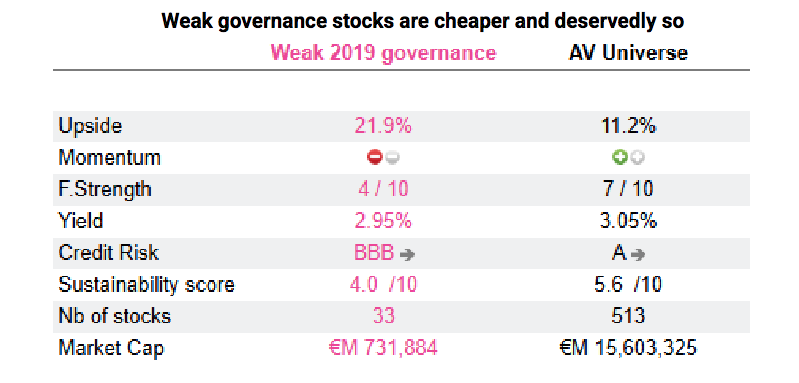
Alphavalue has been tracking changes in governance aspects over the past 20 years. An analysis of the group with the worst governance metrics in 2019 – a time when ESG was all the rage – reveals limited progress in this area and underperformance in share price.
Divacons Report
We have carried out a retrospective assessment of governance scores. Although ESG (Environmental, Social and Governance) criteria no longer attract the interest of most investors, governance remains the most significant factor, regardless of such interest. Alphavalue has tracked changes in governance aspects over a 20-year period, enabling us to verify whether efforts have been made to address governance shortcomings and what impact this has had on valuation.
When analysing the group with the worst governance metrics in 2019 – a time when ESG was in vogue and the COVID-19 pandemic had not yet struck – limited progress in governance and weaker share price performance can be observed. Stocks with a score below 3.3/10 were selected to narrow the sample down to 33 governance ‘zombies’ from within Alphavalue’s coverage of over 500 stocks. This group represents only a small fraction of that coverage.
Looking first at their past and current governance ratings, this group’s average score in 2019 was just 2.8/10, whilst it currently stands at 3.6/10. This improvement of 0.8 out of 10 contrasts with the 0.5 out of 10 improvement recorded across Alphavalue’s entire coverage, which averages 6.8 out of 10. Although all companies have improved their governance, those with a poor profile remain so.
On a positive note, the boards of directors of these lagging companies are becoming progressively more independent. Alphavalue applies its own rules to define the independence of a board member. The proportion of independent directors out of the total board rose from 23 per cent in 2019 to 31 per cent in 2026.
However, there is still work to be done, given that the average for our entire coverage stands at 49 per cent in 2026, compared with 40 per cent in 2019. In other words, companies with governance shortcomings are making slow progress in improving their performance.
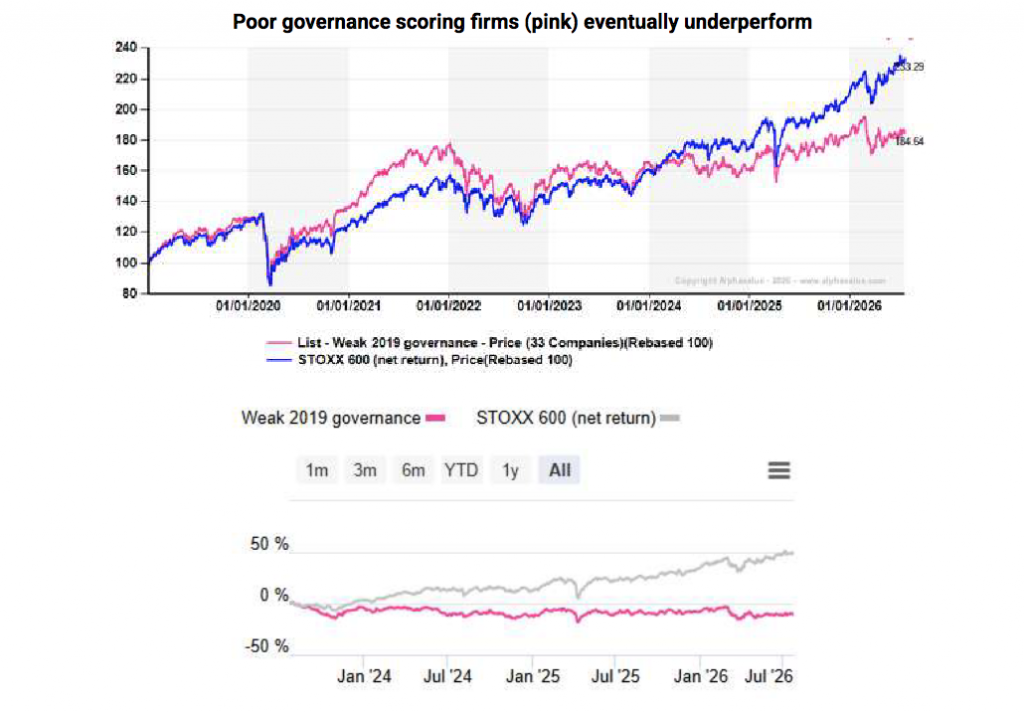
Indeed, these companies pay a high price for this failure to respect a fundamental pillar of corporate life. The equally weighted performance of the 2019 governance laggards (shown in pink) is presented below. Interestingly, the markets showed no interest in governance shortcomings when post-COVID-19 expectations drove up all assets and inflation helped to accelerate profits.
Following the Fed’s warning and the subsequent return to normal operations, shares with governance deficiencies underperformed the STOXX 600 substantially. From 2024 onwards, this underperformance becomes significant (second chart).
The reason these companies underperform the index likely lies in their combined weak fundamentals. Although this may constitute a tautology or circular reasoning, it is worth reiterating. Companies with weak governance do not represent a viable option and do not appear to be cases of spontaneous recovery.