European economy

European banks management

Covid-19: The First Real-Life Stress Test For European Banks Since Post-GFC De-Risking

Scope Ratings | European banks have proven resilient in the face of Covid-19. There has been no banking crisis and no bank has come close to resolution. Supportive fiscal, monetary and supervisory policies have offset credit, funding and solvency risks. Most banks entered the crisis with healthy balance sheets. Balancing the stabilisation effect of the expected rebound against asset-quality deterioration, and factoring in business-model adjustments will underpin our rating approach to the EU banking sector next year.


Bulgaria

Bulgaria-Recession Softened By Fiscal And Monetary Measures

Crédito y Caución (Atradius) | Bulgaria’s monetary policy framework is strong, with a solid commitment to its currency board arrangement (the lev has been pegged to the euro since 1997). As a result, the Bulgarian Central Bank usually follows monetary policy decisions made by the European Central Bank. Although Bulgaria entered the Exchange Rate Mechanism II of the EU in June 2020, an adoption of the euro seems rather unlikely in the short run. While the currency peg supports foreign investor confidence, it somehow limits Bulgaria’s ability to combat external imbalances.


Eurogrupo Europa chuli

The EU Unblocks Recovery Fund In Return For Delaying Rule Of Law Regulation For Hungary And Poland

The European Council has reached an agreement on the Rule of Law Mechanism’s application that convinces Hungary and Poland and the rest of the 25. Thus, the European Commission commits itself not to develop the specific regulation on this Mechanism and not to publish the guidelines that will structure its working until the EU’s Court of Justice has ruled on whether the mechanism is fully in accordance with European law or not. This may take between six months and a couple of years. Aids from the EU recovery fund could begin to flow from June 2021. 


EZforecastok

Eurozone-2020 Not Ending Fast Enough

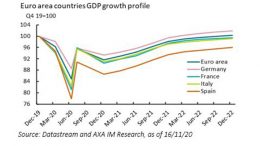
Apolline Menut (AXA IM) | For Eurozone economies, 2020 cannot end soon enough. After a 15.1% decline in the first half of the year and a strong, but partial, rebound in the Q3, the euro area economy is set to contract again in Q4 (-4.1%qoq). The autumn lockdowns triggered by the pandemic’s second wave are less restrictive than in the spring (schools, the public sector and industry remain open this time), and so is our assumption of activity hit (-10% in November on average for the euro area versus around -25% in April). But the euro area will finish the year 8.3 percentage points (ppt) below end-2019 levels and with large dispersion across countries. Virus developments, stringency of restrictions, exposures to the most affected sectors (Exhibit 1) and fiscal supports vary across countries. For that reason, we see German growth shrinking by “only” 6%yoy in 2020, half of the contraction we expect in Spain, and much better than the 7.7% decline we project for the euro area as a whole.


Sin título 3

Busy Thursday

This Thursday could be a key moment for Europe, with the ECB meeting and the beginning of the European council. We could get a positive surprise on the time extension of PEPP, but the constraints on the “top-up” are significant. There is some tentative progress on the “rule of law” spat but hurdles abound. The Council meeting could bring about the denouement of the Brexit saga.


Germany labour market

ifo Institute: Coronavirus Crisis Threatens Survival of 15 Percent of German Companies

The coronavirus crisis threatens the survival of 15 percent of German companies, according to their responses to the ifo Business Survey for November. “That’s an improvement over June, when the figure was 21 percent,” says Klaus Wohlrabe, Head of Surveys at ifo. “Nevertheless, 86 percent of travel agencies and tour operators currently feel threatened, as do 76 percent of hotels and 62 percent of restaurants.”


sector auto spain

Manufacturing PMIs: Second Wave Slows The Recovery Momentum

Activity slowed in November in many European countries, but remained at a relatively fast speed of expansion in most economies, except for Spain and France, where manufacturing activity contracted. Two surprises are worth mentioning: Sweden and Switzerland saw a stronger acceleration of manufacturing activity in October. 


negative rates2

The Blunder Of Negative Interest Rates

Miguel Navascués | The depression and the drop in inflation -or even deflation- have led the central banks to try a disastrous experiment: negative interest rates. Even Christine Lagarde speaks of putting the reference interest rate at -2%. This has been a mistake for several reasons. It discourages the holding of liquid deposits (which logically yield zero or negative), but it does not make people anticipate consumption, if prices stagnate or fall.


Europeok

Western Europe: Overdue invoices and write-offs increase dramatically

Crédito y Caución (Atradius) |For many businesses around the world, 2020 has been the most challenging year experienced for some time. Global GDP is forecast to contract by more than 4% this year, world trade by about 15% and insolvencies to increase by 26%. Without exception, every country polled in Europe reported an increase in late payments which corresponds to an average two-thirds increase on pre-pandemic figures for the whole region. This would make a bigger downturn than the 2008/2009 recession.