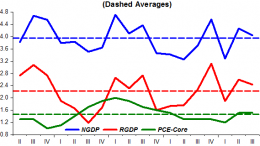
“All quiet on the economic front”
SAO PAULO | By Marcus Nunes via Historinhas | There´s absolutely nothing new on the economic front! So why there´s so much talk about “policy normalization” (i.e. increase in rates)?

SAO PAULO | By Marcus Nunes via Historinhas | There´s absolutely nothing new on the economic front! So why there´s so much talk about “policy normalization” (i.e. increase in rates)?

Maury N. Harris, Drew T. Matus, et al. (UBS) | The National Retail Federation (NRF) has released its estimates for a 4.1% y/y rise in holiday sales—among the stronger growth forecasts in recent years. Although sales have fallen short of NRF expectations in each of the last two years, trends in income and confidence suggest better for this year. Falling energy prices also help.
By Jian Chang (Barclays) | The PBoC announced after the market close on Friday it was lowering the benchmark interest rates, effective 22 November 2014. The cut will be asymmetric, with the 1y lending rate down by 40bp to 5.6% and the 1y deposit rate down by 25bp to 2.75% (Figures 1 and 2). Meanwhile, the central bank further advanced its interest rate liberalization agenda. Banks can offer deposit rates at 20% above the benchmark rate, up from 10% currently (the upward flexibility was first introduced in June 2012, also along with a 25bp cut in the deposit rate). The bank also removed the benchmark guidance for the 5y savings rate.

WASHINGTON | By Pablo Pardo | Having €2.83 trillion in the bank and not knowing what to do with it is a problem that everybody would love to have. But it is actually a really serious problem for 316.1 million Americans, especially for those whose income increased by 0.43% in 2013. And, by extension, for the other 6.8 bn of human beings in the planet. Behind this problem there is a lack of investment opportunities, without which investment in the US will remain in a state of weakness and heavily dependent on an inability to increase consumption.

WASHINGTON | By Pablo Pardo | In the 1Q14, companies at Standard and Poor’s 500 spent more money to repurchase shares in comparison to the profits they had made during that period. And third quarter data point in the same direction. Large American firms do this for several reasons, such as inflating their share price –because, the fewer number of shares, the more profits per share they’ll have, which in turn benefits managers, who receive financial compensation in the form of company shares.

By Miriam L. Campanella via Caixin | The supply of U.S. dollars in the global economy is set to shrink, and the yuan could fill the void if Chinese leaders and international monetary institutions are prepared to act
BEIJING | By Sean Miner via Caixin | The United States and China disagree on many issues but especially in the foreign policy sphere, and there are few reasons the two economic heavyweights will become closer in the next few years. Among the few areas that could bring them closer could be increased bilateral investment. With the recent “breakthrough” between China and the United States in the negotiations on the Information Technology Agreement, the prospects for a bilateral investment treaty (BIT) between them have been improved.
SAO PAULO | By Marcus Nunes via Historinhas | In The Risks to the Inflation Outlook SF Fed researcher Vasco Cúrdia writes: the median inflation forecast is not expected to return to the FOMC target of 2% until after the end of 2016. The uptick in inflation in the first half of 2014 could lead one to believe inflation is finally on the path back toward its target. However, inflation has shown similar patterns several times before and each time the uptick has never lasted very long. According to this model, we should not see inflation begin to recover more firmly until around the end of 2015.

MADRID | By Sean Duffy | Recession in Japan is the latest symptom of the faltering global recovery. As Tokyo reappraises the prescriptions of Abenomics, ECB’s Draghi attempts to bolster confidence with sovereign bonds reference.
By Volker Stanzel via Caixin | The world debate may be preoccupied with crises in the Middle East and in eastern Ukraine and with ISIS and fighting Ebola. Yet, tensions in East Asia have not subsided. Even though the region has seen quite a remarkable level of peace since China’s war against Vietnam in 1978-79, there is a new uncertainty.